


Have you ever paused mid sentence, unsure whether you meant flatform or platform? You are not alone. These two words look almost identical on the page, share several letters, and even share a bit of history, yet they belong to completely different worlds. One lives in shoe stores and fashion blogs. The other lives almost everywhere else, from boardrooms to train stations to your phone’s app store.
Mixing them up does more than look like a typo. It can confuse readers, weaken your credibility as a writer, and send the wrong message in professional content. Imagine reading a business proposal that mentions a “flatform for managing logistics,” or a fashion review that calls a wedge sandal a “platform” when it actually has a perfectly level sole. In both cases, the mismatched word creates a small but noticeable disconnect between what the writer meant and what the reader understood.
This guide walks through exactly what each word means, how to use both correctly, and where the lines occasionally blur. You will see clear definitions, real sentence examples, a breakdown of common mistakes, and a look at the rare exceptions that keep this topic interesting. By the end, you will know precisely when to reach for flatform and when platform is the only word that makes sense.
Define Flatform
A flatform is a specific style of shoe. It combines two ideas: a flat sole and the added height of a platform. Unlike a traditional platform shoe, a flatform has no heel elevation at all. The sole stays level from the toes all the way to the heel, so the foot never tilts forward or backward.
Picture a wedge sneaker or a chunky summer sandal that lifts you off the ground without forcing your foot into an angled position. That lift comes from a thick, evenly distributed sole rather than a raised heel. This design is exactly what makes flatforms popular with people who want extra height but cannot tolerate the discomfort of a steep heel.
The term itself emerged as fashion writers and shoe designers needed a quick way to describe this hybrid construction. Rather than coining something entirely new, they fused “flat” with “platform,” and the resulting word stuck once designers began releasing flatform sneakers and sandals during major fashion seasons.
Key traits of a flatform include:
- A uniformly thick sole from heel to toe
- No slope or incline anywhere in the footbed
- Added height without the balance challenges of a heeled platform
- Common in sandals, sneakers, boots, and even some dress shoe styles
- Often favored for festivals, travel, and long days on your feet because the flat base distributes weight more evenly
The word itself is a blend of “flat” and “platform,” and that blend tells you almost everything you need to know. It is not a general English word you will find used outside fashion and footwear contexts. If someone uses flatform anywhere else, in software, in business, in architecture, it is almost certainly a mistake for platform. Outside of a small number of historical nautical references covered later in this guide, the term simply does not have a foothold beyond fashion writing.
Define Platform
Platform is one of the most flexible words in the English language. At its root, a platform is a raised, flat surface that sits higher than the ground or area around it. According to Merriam-Webster, a platform is a flat horizontal surface usually higher than the surrounding area. That original physical meaning is still very much alive, but over the centuries the word has stretched to cover dozens of unrelated industries.
This kind of semantic stretching is common in English. A word starts with a concrete, physical meaning, and as new technologies and industries emerge, writers reach for the closest existing word rather than inventing something new. That is exactly what happened with platform, and now the word does heavy lifting across an enormous range of fields.
Here is a quick look at how widely platform is used today:
| Context | What Platform Means |
|---|---|
| Footwear | A shoe sole built up to add height, often with a heel angle |
| Technology | The hardware or software environment where applications run |
| Transportation | A raised area where passengers board trains, buses, or planes |
| Business | A system or service that connects buyers, sellers, or users |
| Politics | A formal set of principles or goals a candidate or party supports |
| Public speaking | A stage or raised area where someone addresses an audience |
| Construction | A built structure designed to support people, equipment, or loads |
| Media | A space or outlet, such as a publication, used to share opinions |
This versatility is exactly why platform shows up everywhere. A social media platform like Instagram, a cloud computing platform like AWS, and a train platform at your local station all use the same root word, even though they describe entirely different things. The thread connecting them is the idea of a foundation, a base that something else is built on top of or operates from.
In technology specifically, the word usually refers to the underlying hardware or software environment that allows other programs to run. Operating systems such as Windows, iOS, and Android are platforms in this sense. Programming environments such as Java and .NET are platforms too, because developers build applications on top of them rather than starting from raw machine code. Social networks like Facebook and X are also described as platforms because they provide the infrastructure that allows millions of users to create, share, and interact with content.
In footwear specifically, a platform shoe can include a heel that sits higher than the toe, creating a noticeable slope. That single structural detail is the clearest dividing line between a platform shoe and a flatform shoe, and it is worth remembering because it comes up again and again throughout the rest of this guide.
How To Properly Use The Words In A Sentence
Choosing correctly between these two words comes down to one simple test: are you talking about a specific type of flat-soled shoe, or are you talking about literally anything else? If it is the second option, platform is almost always the right call.
It also helps to think about the role each word plays in a sentence. Both function primarily as nouns, but platform shows up far more often as part of a compound phrase. Writers attach a descriptive word in front of it, such as software platform or launch platform, to narrow down which meaning they intend. Flatform rarely needs that kind of qualifier because its meaning is already narrow.
How To Use Flatform In A Sentence
Flatform works as a noun naming the shoe itself, or as an adjective describing the style. It belongs almost exclusively in fashion, footwear, and style writing. A few guidelines:
- Use it when describing shoes with a flat, evenly elevated sole and no heel slope
- Pair it with descriptive words like sandals, sneakers, or wedges for clarity
- Avoid using it as a stand-in for any non-footwear meaning
- Use it confidently in product titles, fashion blogs, and style guides, where readers already expect footwear vocabulary
For example: “She bought a pair of canvas flatform sneakers for the festival.” Here, flatform clearly describes the shoe’s construction, not a system or structure of any kind. Notice how the sentence still works smoothly even without extra explanation, because the surrounding words about sneakers and festivals already signal a fashion context.
How To Use Platform In A Sentence
Platform fits almost any context that involves a raised surface, a system, or a structure that supports activity. Because the word covers so much ground, adding a descriptive word before it often improves clarity. Saying “platform” alone in a tech conversation is fine, but specifying “e-commerce platform” or “cloud platform” removes any ambiguity.
For example: “Our company switched to a new cloud platform to handle customer data more efficiently.” In this sentence, platform clearly refers to a technology system, not footwear. Adding “cloud” sharpens the picture and helps the sentence perform better for readers skimming quickly.
More Examples Of Flatform & Platform Used In Sentences
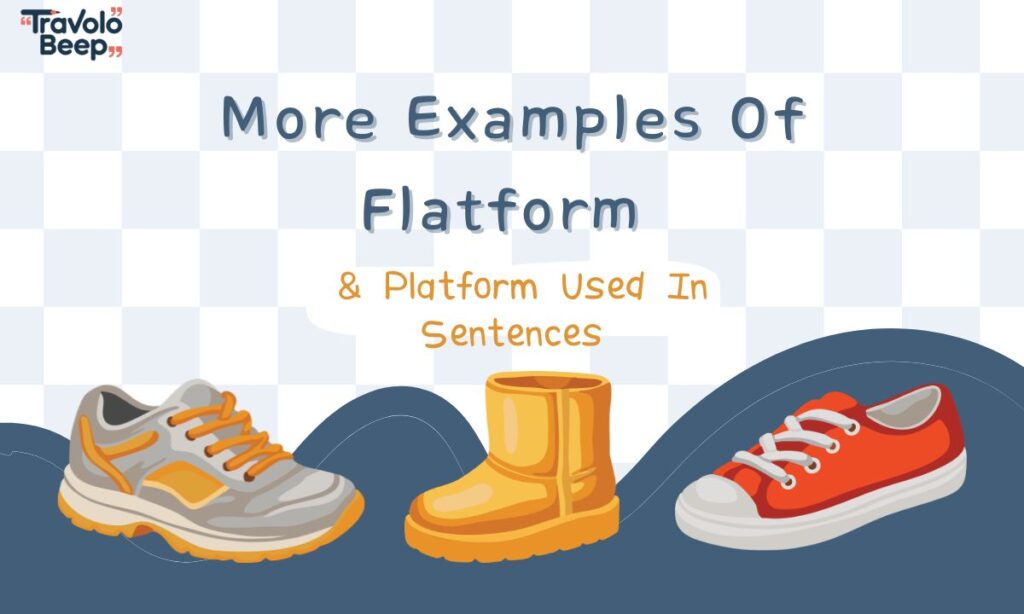
Seeing the words in action across different situations makes the distinction stick. Below are practical examples for both terms, covering casual speech, retail writing, and professional contexts.
Examples Of Using Flatform In A Sentence
- The bride chose ivory flatform sandals so she could dance comfortably all night.
- Flatform boots became a runway favorite during the spring fashion shows.
- He prefers flatform sneakers over heeled platforms because they feel more stable on uneven sidewalks.
- The boutique’s new collection features suede flatforms in five different colors.
- Wearing flatforms all day left her feet far less tired than her old platform heels did.
- Travel bloggers often recommend flatform sandals for sightseeing because they balance height with comfort.
- The designer explained that the flatform silhouette was inspired by retro 1970s footwear trends.
- My sister wore espadrille flatforms to the outdoor wedding and never once complained about sore feet.
Examples Of Using Platform In A Sentence
- The train platform was packed with commuters during the morning rush.
- Our marketing team built a new platform to manage email campaigns automatically.
- The candidate’s political platform focused heavily on education funding.
- She stepped onto the wooden platform to deliver her speech to the crowd.
- The startup launched its app on a single platform before expanding to others.
- Engineers are testing the oil platform’s safety systems ahead of the storm season.
- Developers chose a cross-platform framework so the app would run on both iOS and Android.
- The publishing platform allows writers to track their article performance in real time.
- City officials approved funding to extend the subway platform for longer trains.
Notice how platform shifts meaning depending on the sentence, while flatform always points back to the same idea: a flat-soled shoe with extra height. That consistency is actually a useful memory trick. If you ever find yourself unsure which word to use, ask whether the sentence could only be describing footwear. If yes, flatform is likely correct. If the sentence could apply to technology, business, transportation, or almost anything else, platform is the safer choice.
Common Mistakes To Avoid
Even careful writers slip up with these two words. Most mistakes fall into a handful of predictable patterns, and recognizing them is the first step toward avoiding them entirely.
Using “Flatform” Instead Of “Platform”
This is the most frequent error, and it usually happens because the words look so similar at a glance, or because flatform contains the word platform inside it. Mobile keyboards make it worse, often autocorrecting flatform back to the far more common platform, which can introduce errors in the opposite direction too. A writer who genuinely means flatform might find their phone quietly swapping it for platform without them noticing.
Wrong: “Our business needs a reliable flatform for managing customer communications.” Right: “Our business needs a reliable platform for managing customer communications.”
Wrong: “The new flatform will allow developers to build scalable applications.” Right: “The new platform will allow developers to build scalable applications.”
If the topic is technology, business, transportation, or anything unrelated to shoes, flatform should never appear in your writing. A quick search for the word “flatform” in your draft, followed by a manual check of each instance, can catch this error before publishing.
Assuming All Platforms Are The Same
Because the word platform covers so many industries, it is easy to treat every platform as interchangeable. They are not. A social media platform, a cloud computing platform, and a content management platform each serve different purposes, audiences, and technical needs.
Treating them as identical leads to vague, unhelpful writing. A reader expecting specific guidance about choosing an e-commerce platform will not be served by generic advice meant for social platforms.
Not Understanding The Benefits Of Each Platform
A related mistake is failing to research what a specific platform actually does well. WordPress, for instance, is widely used for content publishing and search visibility, while Salesforce focuses on managing customer relationships and sales pipelines. Writing about either without understanding its strengths produces shallow, generic content that does not help the reader make a real decision.
This matters even more in technical or business writing, where readers are often comparing options before making a purchase or investment. A guide that lumps every platform together under one vague description fails the exact readers it is meant to help.
Offering Tips To Avoid These Mistakes
A few simple habits will keep your writing accurate:
- Ask yourself if the sentence is about footwear. If not, use platform.
- Add a descriptive word before platform (social media platform, train platform, software platform) to remove ambiguity.
- Research the specific platform you are writing about instead of treating it as generic.
- Proofread specifically for flatform appearing outside fashion contexts.
- When uncertain, check a trusted dictionary or style guide before publishing.
- Read your sentence back and ask whether a reader unfamiliar with the topic would understand exactly what kind of platform or shoe you mean.
These habits take only a few extra seconds per sentence, but they consistently produce clearer, more professional writing.
Context Matters
The single biggest factor in choosing the right word is context. The same letters arranged the same way can mean something entirely different depending on the subject, the audience, and the purpose of the writing. A word that fits perfectly in a fashion blog post might look completely out of place in a software review, and a word that sounds natural in a technology article would feel oddly formal in a casual style guide.
This is part of what makes English challenging for both new learners and experienced writers. Context does not just hint at meaning, it often determines meaning entirely. The word platform on its own could refer to a stage, a shoe, a political stance, or a piece of software.
Examples Of Different Contexts
| Context | Correct Term | Sample Sentence |
|---|---|---|
| Fashion blog | Flatform | “These flatform espadrilles are perfect for summer.” |
| Tech review | Platform | “This app runs on both the iOS and Android platform.” |
| Public transit | Platform | “Passengers should wait behind the yellow line on the platform.” |
| Political coverage | Platform | “The senator’s platform includes healthcare reform.” |
| Shoe retail listing | Either, depending on structure | “Choose between our heeled platform sandals or flat-soled flatforms.” |
| Business software | Platform | “The CRM platform integrates with your existing email tools.” |
| Public speaking event | Platform | “The keynote speaker addressed the audience from a raised platform.” |
| Construction industry | Platform | “Workers assembled a temporary platform before installing the roof beams.” |
Reading the surrounding sentence almost always tells you which word belongs. If shoes, soles, or footwear are mentioned, flatform might apply. If the topic involves systems, stages, structures, or technology, platform is the safer and almost always correct choice.
Writers who specialize in a single field rarely struggle with this distinction. The confusion tends to appear most often when someone writes across multiple industries, such as a lifestyle blog that covers fashion one week and technology the next.
Exceptions To The Rules
Language rarely stays perfectly tidy, and a few specialized fields bend the general guidelines slightly. These exceptions are worth knowing, even though they remain uncommon in everyday writing, simply because they explain why you might occasionally encounter flatform outside of fashion.
1. Nautical Terminology
In some older or highly specialized maritime texts, flatform has occasionally been used to describe a flat, level deck surface on a vessel. This usage is rare and largely historical rather than current. Meanwhile, platform remains standard in nautical writing for raised structures such as observation decks or diving platforms on ships. If you are writing modern maritime content, platform is still the safer and far more recognized term.
2. Shoe Design
Within footwear itself, flatform and platform frequently appear side by side, yet they describe structurally different products. A platform shoe can include a heel positioned higher than the toe, creating a visible incline. A flatform shoe keeps the entire sole level, with no incline anywhere in the footbed. Both fall under the broader umbrella of elevated footwear, but a product description that swaps one for the other can genuinely mislead a shopper looking for a specific fit.
This distinction matters more than it might seem. Someone with foot or back pain might specifically seek out flatforms because the level sole reduces strain compared to an angled platform heel. Mislabeling a product, even by a single word, can lead to returns and lost trust in a retailer’s descriptions.
3. Software Development
In rare developer conversations, especially casual discussions, you might see flatform used loosely as a typo-turned-joke for a particularly simplified platform. This is not standard usage and should be avoided in any professional or published writing. It tends to appear only in informal chat threads, never in documentation or anything meant for a general audience.
Stick with platform, paired with a clear descriptor such as development platform or deployment platform, for accurate and professional results.
Practice Exercises
Testing your understanding is the fastest way to make the distinction permanent. Try the exercises below before checking your answers, and resist the urge to peek ahead too quickly.
Exercise 1: Fill In The Blank
Choose flatform or platform for each sentence.
- She wore strappy ______ sandals to the beach party.
- Our startup is building a new ______ for online tutoring.
- The commuter train pulled into the ______ right on schedule.
- He prefers ______ sneakers because they keep his feet level all day.
- The company’s social media ______ reaches millions of users daily.
- The shoe brand released a limited edition ______ boot collection this fall.
- City council debated whether to extend the subway ______ to handle more passengers.
Answers: 1. flatform, 2. platform, 3. platform, 4. flatform, 5. platform, 6. flatform, 7. platform
Exercise 2: Sentence Writing
Write one original sentence using flatform and one using platform. Try applying them to two different fields, such as fashion and technology, to reinforce how dramatically the meaning shifts with context. For an extra challenge, write a third sentence that uses platform in a completely different field than your first two, such as politics or public speaking, to see how flexible the word truly is.
Reading your sentences back out loud often makes any leftover confusion easy to spot. If a sentence sounds slightly off when you say it aloud, there is a good chance the wrong word has slipped in.
You can also checkout this article as well Seing Vs Seeing: What’s The Correct Spelling To Use?
Conclusion
Flatform and platform may share letters, but they do not share meaning. Flatform belongs to fashion, describing a flat-soled shoe with added height and no heel slope. Platform belongs almost everywhere else, from technology and business to transportation and public speaking. Check the context, add a clarifying word when needed, and you will never confuse the two again.