
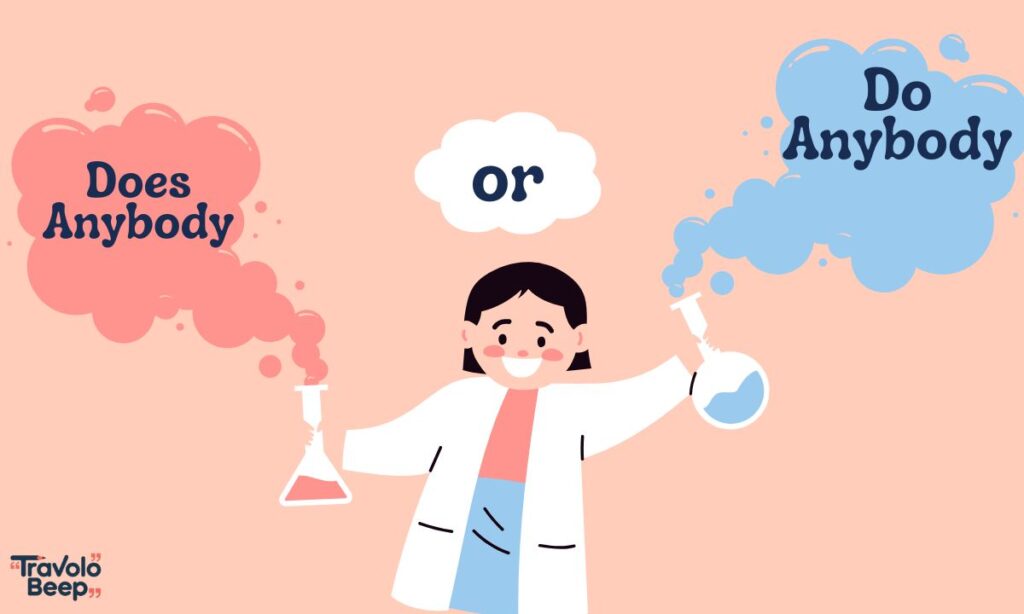

Have you ever paused mid sentence, unsure whether to ask “does anybody know?” or “do anybody know?” You are not alone. This is one of the most common grammar mix ups among English learners and even confident native speakers. The confusion usually comes from a simple misunderstanding about how indefinite pronouns behave with helping verbs.
In this guide, you will get a clear, no nonsense answer, plus the reasoning behind it, real world examples, common mistakes, and simple memory tricks so you never second guess yourself again.
Does Anybody or Do Anybody: Which is Correct?
The correct phrase is “does anybody.” Saying “do anybody” is grammatically incorrect in standard English and should be avoided in speech, writing, emails, and any formal communication.
This rule exists because “anybody” is treated as a singular pronoun in English grammar, even though it can refer to a group of unspecified people. Since it behaves like “he,” “she,” or “it,” it pairs with “does,” not “do.”
The Quick Answer
If you only remember one thing from this article, remember this:
- Use “does anybody” in present tense questions and statements.
- Never use “do anybody.” It breaks basic subject verb agreement rules.
- Use “did anybody” when talking about the past.
| Phrase | Correct or Incorrect | Example |
|---|---|---|
| Does anybody | Correct | Does anybody want tea? |
| Do anybody | Incorrect | Do anybody want tea? |
| Did anybody | Correct (past tense) | Did anybody call earlier? |
That is the core rule in a nutshell. Now let us look at why it works this way, so the logic sticks with you long term.
Understanding Indefinite Pronouns: The Foundation
To understand why “does anybody” is correct, you first need to understand what an indefinite pronoun actually is.
An indefinite pronoun refers to a person, place, or thing without naming it specifically. Instead of saying “John” or “the teacher,” you use a general word that could apply to anyone or anything. These pronouns are called “indefinite” precisely because they do not point to one particular, named individual.
Here is the part that trips people up: even though an indefinite pronoun like “anybody” can refer to a whole group of unnamed people, English grammar treats it as a single, singular unit. That single detail is the reason the entire “does versus do” debate exists.
Common Examples of Indefinite Pronouns
Indefinite pronouns show up constantly in everyday conversation. Some of the most common ones include:
- Anybody, anyone, anything
- Somebody, someone, something
- Everybody, everyone, everything
- Nobody, no one, nothing
- Each, either, neither
All of the pronouns ending in “body,” “one,” or “thing” are grammatically singular. That means they follow the exact same rule as “anybody” when it comes to choosing between “do” and “does,” or between “was” and “were.”
The Role of Auxiliary Verbs: “Do” vs “Does”

“Do” and “does” are auxiliary, or helping, verbs. Their job is to support the main verb in a sentence, especially when forming questions or negatives in the present simple tense.
You cannot naturally ask “Anybody knows the answer?” in standard English. It sounds unfinished. Instead, the helping verb steps in to create a proper question: “Does anybody know the answer?”
The choice between “do” and “does” depends entirely on the subject of the sentence, following the rules of subject verb agreement.
When to Use “Do”
Use “do” with the following subjects:
- I: Do I need a jacket today?
- You: Do you understand the instructions?
- We: Do we have enough time?
- They: Do they agree with the plan?
Notice that all of these subjects are either first person, second person, or plural third person. None of them are singular third person, which is exactly where “does” takes over.
When to Use “Does”
Use “does” with singular third person subjects, including:
- He: Does he know the way?
- She: Does she need help?
- It: Does it work properly?
- Singular nouns: Does the store close early?
This is also where indefinite pronouns like “anybody,” “anyone,” and “everybody” fit in, since grammar treats them exactly like “he,” “she,” or “it.”
Why “Anybody” Takes “Does”
“Anybody” is a third person singular pronoun. Even though it can describe an unlimited number of possible people, grammatically it functions as one singular unit, the same way “someone” or “everybody” does.
Because of this, “anybody” requires the singular form of the auxiliary verb, which is “does,” not the plural or general form “do.” This is not a stylistic preference. It is a firm rule of subject verb agreement in standard English.
The Logic Behind “Does Anybody”
Here is a simple way to visualize the logic:
| Subject Type | Example Subject | Correct Helping Verb |
|---|---|---|
| Singular pronoun | He, she, it | Does |
| Indefinite singular pronoun | Anybody, anyone, everybody | Does |
| Plural or first/second person | I, you, we, they | Do |
Since “anybody” sits in the same category as “he,” “she,” and “it,” it automatically inherits “does” as its helping verb. Once you see this pattern, the confusion tends to disappear for good, because it applies consistently across nearly every similar pronoun in English.
One more detail worth remembering: when “does” is already doing the work of showing tense and agreement, the main verb stays in its base form. That means you say “does anybody want,” never “does anybody wants.” The “-s” only appears once, on the helping verb.
Examples of Using ‘Does Anybody’ in a Sentence
Seeing the phrase in context makes it easier to internalize. Here are several natural examples:
- Does anybody have a spare charger?
- Does anybody know what time the meeting starts?
- Does anybody want to grab lunch together?
- Does anybody mind if I open the window?
- Does anybody remember where I parked the car?
In every one of these sentences, “anybody” is the subject, and “does” correctly signals that the subject is singular in grammatical terms, even though the question is open to any number of people.
Common Mistakes and How to Avoid Them
Even fluent speakers slip up sometimes, especially in casual speech. Here are the most frequent errors people make and how to correct them.
| Incorrect Sentence | Corrected Sentence |
|---|---|
| Do anybody have a pen? | Does anybody have a pen? |
| Do anybody know the answer? | Does anybody know the answer? |
| Does anybody wants coffee? | Does anybody want coffee? |
| Do anyone need help? | Does anyone need help? |
A quick way to catch these mistakes is to mentally swap “anybody” with “he” or “she.” If the sentence sounds wrong with “he” or “she,” it is wrong with “anybody” too. “Do he want coffee?” clearly sounds off, which confirms that “do anybody want coffee?” is equally incorrect.
Similar Grammar Mistakes with Indefinite Pronouns
The “does versus do” confusion is not limited to “anybody.” The same pattern, and the same mistakes, show up with other indefinite pronouns.
- Incorrect: Do everybody agree? Correct: Does everybody agree?
- Incorrect: Do somebody want to help? Correct: Does somebody want to help?
- Incorrect: Do anything change? Correct: Does anything change?
- Incorrect: Anybody are coming? Correct: Is anybody coming?
Notice that the last example uses “is” instead of “does,” because that particular sentence uses “to be” rather than a general action verb. The underlying rule stays the same though: indefinite pronouns are singular, so they always pair with singular verb forms, whether that is “does,” “is,” or “has.”
Tips for Remembering the Correct Form
If the grammar terminology feels overwhelming, these practical tricks can help lock in the rule for good:
- Substitute with “he” or “she.” If “does he” sounds correct, then “does anybody” is correct too.
- Remember the “body” trick. Words ending in “body,” “one,” or “thing” almost always take singular verbs.
- Think of one invisible person. Even though “anybody” could mean many people, imagine it as one unnamed individual standing in for the group.
- Say it out loud. “Do anybody” often sounds noticeably off to a trained ear, even before you consciously identify why.
- Practice with real sentences. Write five questions using “does anybody” until the pattern feels automatic.
Does Anyone Have or Do Anyone Have?
The same logic applies here. “Does anyone have” is correct, while “do anyone have” is not. “Anyone” is simply another indefinite pronoun that behaves exactly like “anybody” and “everybody.” For example, “Does anyone have a charger I could borrow?” is the standard, grammatically correct way to phrase the question.
Should I Use ‘Wants’ or ‘Want’ After ‘Does Anyone’?
This is a detail that trips up even careful writers. The correct phrasing is “does anyone want,” not “does anyone wants.”
Here is why: the helping verb “does” already carries the singular “-s” ending needed to match the subject. Once “does” has done that job, the main verb returns to its base, uninflected form. Adding another “-s” to the main verb creates a double marking error, similar to saying “does he wants” instead of “does he want.”
Can “Anybody” Ever Be Used with “Do”?
In standard, formal English, no. “Anybody” always requires “does” in the present tense, regardless of context.
However, in casual spoken English, especially in certain regional dialects or very informal conversation, you might occasionally hear “do anybody” used loosely. This is considered nonstandard and should never be used in professional writing, academic work, exams, or formal speech. If you want your English to sound polished and accurate, “does anybody” is the only safe choice.
What About “Does Anybody Else”?
Adding “else” does not change the grammar rule at all. “Else” simply adds the meaning of “in addition to” or “other than the person already mentioned,” but it has no effect on whether you use “do” or “does.”
So the correct phrasing remains “does anybody else,” never “do anybody else.” For example: “Does anybody else want to share their opinion before we move on?” The subject is still singular in grammatical terms, so “does” stays exactly where it belongs.
Past Tense: “Did Anybody”

Good news here: the past tense removes the entire “do versus does” dilemma. In the past tense, English uses “did” for every subject, singular or plural, without exception.
- Did anybody call while I was out?
- Did anybody see where I left my keys?
- Did anybody finish the assignment?
Notice that the main verb after “did” stays in its base form too, just like it does with “does.” You say “did anybody see,” never “did anybody saw.” The helping verb carries the tense, so the main verb does not need to change.
Why Correct Grammar Matters in Professional Settings
Grammar mistakes like “do anybody” might seem small, but they add up in professional and academic contexts. When you write an email, a report, or a job application using “does anybody” correctly, it signals attention to detail and confidence in communication.
On the other hand, a phrase like “do anybody know the update?” in a client email or presentation can subtly undermine how colleagues, managers, or clients perceive your competence. Nobody expects perfection, but consistent grammatical accuracy builds trust over time, especially in written communication where tone of voice cannot soften an error.
This single rule also opens the door to understanding a much bigger grammar concept called subject verb agreement, which governs how subjects and verbs must match in number and person throughout English.
Building Strong Language Skills
Mastering small rules like “does anybody” versus “do anybody” is part of a much larger skill set. Once you understand why indefinite pronouns take singular verbs, you will naturally start using related phrases correctly without overthinking them, including “everyone has,” “someone is,” and “nobody was.”
A few habits that help build stronger grammar instincts over time:
- Read grammatically polished writing regularly, such as well edited articles, books, or news sites.
- Practice writing short questions using different indefinite pronouns.
- Read your own writing aloud before sending important emails or documents.
- Keep a running list of grammar rules that used to confuse you, along with corrected examples.
Small, consistent practice like this compounds quickly, and within a short time, choosing between “do” and “does” becomes automatic rather than something you have to consciously calculate.
Quick Reference Guide
Use this table anytime you need a fast refresher.
| Situation | Correct Form | Example |
|---|---|---|
| Present tense question | Does anybody | Does anybody want pizza? |
| Present tense with “else” | Does anybody else | Does anybody else need a ride? |
| Past tense question | Did anybody | Did anybody call yesterday? |
| Main verb after “does” | Base form, no “-s” | Does anybody want (not wants) |
| Negative statement | Doesn’t (for anybody as subject) | Anybody doesn’t know is unusual; typically rephrased as “nobody knows” |
| Similar pronouns | Anyone, everybody, someone | Does anyone/everybody/somebody agree? |
You can also checkout this article as well Realist Vs. Realest: How Are These Different? When To Use
Conclusion
“Does anybody” is the grammatically correct choice, while “do anybody” is not standard English. The reason comes down to one simple fact: “anybody” is a singular pronoun, so it needs the singular helping verb “does,” just like “he,” “she,” or “it” would. This same rule carries over to “anyone,” “everybody,” “someone,” and their many cousins.
Once this pattern clicks, you will not need to second guess it again. Whether you are writing a casual message or a formal email, sticking with “does anybody” will keep your English accurate, clear, and professional every time.