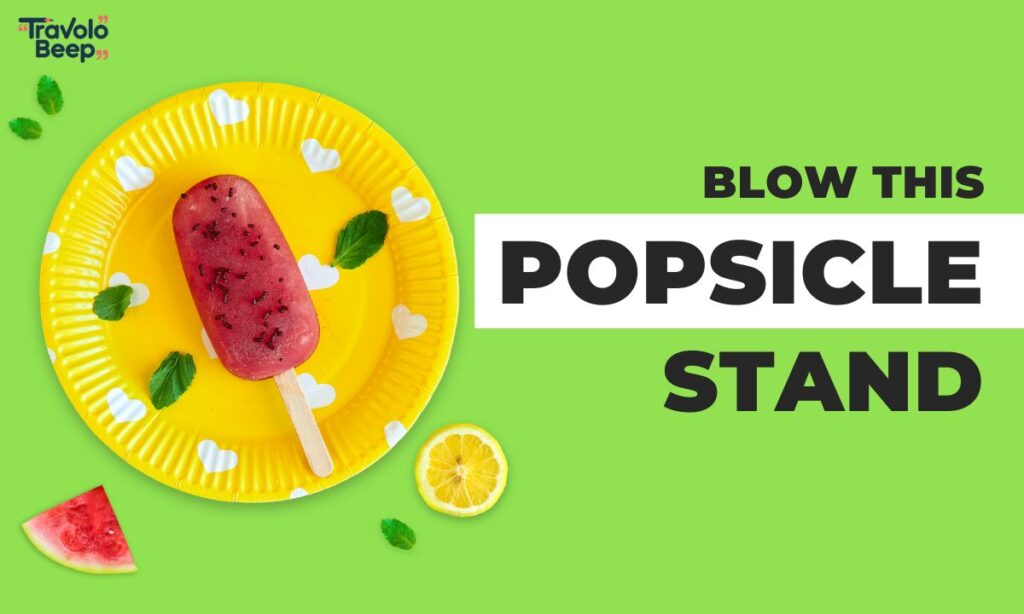

You are mid-way through a dull dinner party, the clock is crawling, and your friend leans over and whispers, “Hey, let’s blow this popsicle stand.” You grin, grab your coat, and walk out. The words sound a little silly, and that is exactly the point. This phrase is one of the most colorful, playful idioms in American English, and once you understand where it came from and how it works, you will reach for it more often than you expect.
This guide covers every angle: what it truly means, how it grew from older slang, where it appeared in pop culture, and exactly when you should or should not use it in conversation or writing.
What Does “Blow This Popsicle Stand” Mean?
At its core, “blow this popsicle stand” is an idiomatic expression that simply means to leave a place. It carries a light, breezy, almost comedic tone. Nobody who says it is angry or in a hurry in any serious sense. It is the conversational equivalent of saying “let’s get out of here” but with ten times the personality.
The word “blow” here does not mean to destroy anything. In mid-20th century American slang, “blow” was widely used to mean departing quickly, as in “blow town” or “blow the scene.” Pair that verb with something as trivial as a popsicle stand, and you get a phrase that suggests the current location is so unimportant that leaving it requires about as much thought as walking away from a kid’s frozen treat cart.
The full expression is most commonly said as:
- “Let’s blow this popsicle stand.”
- “Time to blow this popsicle stand.”
- “How about we blow this popsicle stand?”
All three carry the same meaning: it is time to go, and there is no reason to linger.
Where Did This Saying Come From?
The Random House Historical Dictionary of American Slang (1994) notes that the expression also appears in closely related forms including “blow this pop stand” and “blow this popcorn stand,” with “pop” being the common thread across variants.
A strong linguistic theory holds that the phrase is a softer version of the earlier “let’s blow this joint,” which carried the same meaning dating back to the mid-1940s. As the word “joint” became more associated with marijuana, a more innocuous substitute naturally arose in everyday speech.
In the 1950s, a popular teen hangout was around the local drug store, which used to have a soda shop or soda fountain inside, sometimes called a “pop stand.” In the slang of the day, “let’s blow this pop stand” meant leaving a no-longer-interesting place. Previous phrases had people blowing “this joint,” “this burg,” “this place,” and “this scene” — all meaning the same thing: let’s get out of here.
The origins of this idiom trace back to mid-20th century American slang, particularly the 1950s, when fun and rebellious expressions began flooding pop culture. The phrase captured postwar American optimism a culture ready to move, explore, and make fun of itself.
At some point, the more whimsical “popsicle stand” replaced the plainer “pop stand,” lending the phrase more humor and making it far more memorable. A popsicle stand is a small, seasonal, completely disposable kind of business. Saying you are going to “blow” one communicates that wherever you are currently sitting holds about as much significance as a sidewalk cart on a summer afternoon.
Pop Culture Appearances

The phrase did not spread through textbooks. It spread through screens and speakers.
Marlon Brando, as Johnny Strabler, says “I’m gonna blow this joint” in the 1953 movie “The Wild One.” Robin Williams, as Mork in the television series “Mork and Mindy,” used the expression “How about you and me blow this Popsicle stand?” in a 1980 episode.
One of the earliest film uses appeared in 1957’s “The Blob,” where teen characters use the line before leaving a diner.
These appearances helped cement the phrase in the American cultural vocabulary. Each time a beloved actor or comedian dropped the line, a new generation picked it up.
How to Use It in Conversation
Using this expression correctly is mostly about reading the room. It belongs in casual, informal moments. It is not the kind of thing you drop in a performance review or a business proposal. Think of it as a phrase with a built-in smile: when you say it, people around you are almost certainly going to grin.
The Right Situations
Use “blow this popsicle stand” when:
- A party or social event has run its course and you are ready to leave
- A meeting has gone on far too long and your patience has worn thin
- You and a friend are bored somewhere and want to move on to something better
- You want to suggest leaving in a way that gets a laugh rather than an awkward silence
The Wrong Situations
Avoid the phrase when:
- You are in a formal professional setting such as a board meeting or job interview
- The tone of the conversation is serious or emotional
- You are writing a formal email or official document
- The people you are speaking with may not be familiar with American English idioms
Incorrect usage sounds like: “I will blow this popsicle stand at 5 PM.” The phrase sounds awkward on its own because “let’s” implies shared action. The key is shared urgency. You are inviting others to leave together, not acting alone.
Examples in Everyday Life
Seeing the phrase in context makes its meaning crystal clear. Here are natural, everyday examples across different situations.
At a Social Event
Friend 1: “The music stopped an hour ago and we’ve eaten everything on the buffet table.” Friend 2: “Agreed. Let’s blow this popsicle stand before they start asking us to help clean up.”
At Work
Coworker 1: “That was the longest meeting of my life.” Coworker 2: “It really was. Clock hits six, we blow this popsicle stand and go get tacos.”
On a Weekend Outing
Parent: “Kids, we’ve been at this mall for three hours.” Child: “Can we go home now?” Parent: “Yep. Let’s blow this popsicle stand.”
Among Friends Texting
Alex: “This movie is terrible. Leaving at intermission?” Sam: “Already getting my jacket. Time to blow this popsicle stand.”
In every case, the phrase lands as playful and light. It signals departure without drama, and the mild absurdity of the “popsicle stand” image keeps the mood cheerful even when everyone is bored or ready to leave.
Correct Usage Examples
The table below shows correct versus incorrect ways to use the phrase, so you never accidentally misfire.
| Situation | Correct Usage | Incorrect Usage |
| Leaving a party with friends | “Let’s blow this popsicle stand, I’m wiped.” | “I blow this popsicle stand tonight.” |
| Ending a boring event | “Time to blow this popsicle stand.” | “We will blow this popsicle stand.” |
| Casual text to a friend | “Ready when you are. Blow this popsicle stand?” | “I am going to blow this popsicle stand alone.” |
| Comedy script dialogue | “How about we blow this popsicle stand, partner?” | “The committee shall blow this popsicle stand.” |
The pattern is clear: the phrase works best with “let’s” or “time to” at the front, in informal speech, directed at at least one other person.
Using It in Writing
Writers who want to add personality and warmth to dialogue will find this idiom genuinely useful. A character could simply say “Let’s leave,” but using the idiom injects humor and lightens the tone. Everyone smiles, and suddenly leaving doesn’t feel dreary. That’s the beauty of idioms: they make ordinary interactions memorable.
In fiction, the phrase works especially well for:
- Characters who are witty, nostalgic, or a little theatrical
- Scenes set in the 1950s through 1980s where it would feel historically grounded
- Comedy writing where a character wants to break tension with humor
- First-person narration that aims for a warm, conversational voice
In content writing or casual articles, sprinkling in this phrase signals to readers that the writer has a real personality. It creates a moment of connection because most readers recognize it and smile when they see it.
Context Variations
The phrase is flexible enough to shift across a range of social and creative contexts.
Nostalgic contexts: When used by older speakers or in period settings, the phrase lands with genuine authenticity. Baby Boomers and Gen X speakers often use it naturally, drawing on years of exposure to the phrase through television and film.
Ironic contexts: Younger speakers sometimes deploy the phrase with deliberate awareness of its retro quality. Saying “let’s blow this popsicle stand” at a trendy downtown coffee shop is funnier precisely because of the contrast between the old-fashioned phrase and the modern setting.
Affectionate contexts: Between close friends or family members, the phrase becomes a warm, almost tender shorthand. It says “I am ready to leave, and I want you to come with me,” but in a way that makes everyone feel included and lighthearted.
Written comedy: Screenwriters and novelists use the phrase to signal a character’s age, background, humor level, or relationship to American pop culture. It does a lot of characterization work in very few words.
Is It Still Used Today?
Yes, but less often than before. The phrase peaked in popularity in mid-20th century American culture. Today, it sounds retro on purpose. Many people still use it for exactly that reason. Saying “let’s blow this popsicle stand” in 2026 makes you sound playful and a little old-fashioned at the same time, the kind of phrase that makes people grin because they recognize it but don’t expect to hear it. You will find it in comedy writing, nostalgic content, and casual speech between friends who enjoy colorful language.
The phrase is far from dead. It lives in that sweet spot: old enough to feel charming, familiar enough that almost everyone gets the joke immediately.
Similar Phrases for Leaving
If “blow this popsicle stand” feels like too much for a given situation, or you simply want to vary your language, here are close alternatives with their own distinct flavors.
| Phrase | Tone | Best Used When |
| “Let’s get out of here” | Neutral, universal | Any informal situation |
| “Let’s bounce” | Modern, casual | Among younger speakers |
| “Time to hit the road” | Friendly, adventurous | Leaving for a trip or heading home |
| “Let’s roll” | Energetic, brief | When you want momentum |
| “Let’s make like a tree and leave” | Playful, old-fashioned | When you want a laugh |
| “Let’s blow this joint” | Casual, slightly edgy | Among adults in informal settings |
| “Time to make tracks” | Classic American slang | Nostalgic or humorous contexts |
“Blow this popsicle stand” stands out because it is the most vivid. It paints a clear picture. The others just suggest movement. Something about picturing yourself dramatically departing a frozen treat cart makes the whole act of leaving feel like an adventure rather than an exit.
Memory Tricks for Remembering the Meaning
Idioms can be tricky to remember, especially if you encounter them out of context. Here are a few simple techniques to make this one stick.
Picture the scene. Imagine an actual popsicle stand at a summer fair: small, temporary, unimportant. Now imagine someone dramatically announcing they are leaving it. That exaggerated mismatch between the grand announcement and the trivial setting is the whole joke. Once you picture it, the meaning never leaves you.
Connect it to “blow town.” The older phrase “blow town” means to leave a city quickly and decisively. “Blow this popsicle stand” follows the exact same logic, just with a funnier destination. If you remember that “blow” equals “leave fast,” the rest clicks into place.
Pair it with Robin Williams. If you have ever seen “Mork and Mindy,” picturing Williams saying the phrase with his signature energy is an instant memory anchor. Once you make that connection, the phrase never leaves you.
Think of it as a comic big exit. People make grand entrances. This phrase turns departure into performance. You are not storming out of a palace. You are abandoning a popsicle cart, and somehow that contrast is even funnier.
You can also checkout this article as well After Which in a Sentence: Meaning, Rules, and Real Examples
Conclusion
“Blow this popsicle stand” is one of those rare idioms that does everything right: short, vivid, funny, and impossible to misunderstand once explained. It grew from mid-century American slang, found a home in film and television, and has survived every generation shift because it carries something timeless inside its silliness. Whether you use it at a party, drop it into dialogue, or text it to a bored friend on a slow Saturday, it always lands with a grin. That is the mark of a phrase that earned its place in the language.