
You drive through a settlement of 15,000 people. The sign reads “Town of Millbrook.” Two miles away, a smaller place with 12,000 residents calls itself “Riverside City.” Your brain stalls. Which one is accurate? The answer, perhaps frustratingly, is both. And that is precisely where the confusion begins.
The words city, town, and village appear simple on the surface, yet they carry centuries of legal history, regional inconsistency, and cultural nuance beneath them. Knowing the real difference between these three settlement types is not just a geography lesson. It shapes how zoning laws apply to your property, how services are distributed in your area, how writers describe fictional worlds, and how journalists label real ones. This guide unpacks all of it, from etymology and charter systems to global population thresholds and literary usage, so you walk away with a clear, confident understanding.
Why These Three Words Confuse People
The core problem is that your brain craves clean categories. “Small,” “medium,” and “large” feel intuitive. But city, town, and village sit on a continuum with blurry legal edges, and those edges shift depending on which country, state, or historical period you are looking at.
What qualifies as a city in Wyoming (population threshold: 4,000) would be considered a village in California. A place with 1,600 residents in Wales holds full legal city status, while a settlement of 300,000+ in England was classified as a town until very recently. These are not oversights. They reflect how settlement classifications developed organically over centuries, tied to cathedrals, market charters, royal decrees, and local legislation rather than any universal rulebook.
The confusion is not your fault. It is built into the system.
Core Concepts and Historical Evolution
Etymology and Charter Systems
Each of the three words carries its history in its roots.
Village descends from the Old French vilage, meaning a group of buildings or a rural settlement. Before that, it traces to the Latin villa, a farm or country estate. The word has always implied something small, agricultural, and spatially loose.
Town comes from Old English tun, which referred to a fenced or walled enclosure, such as a homestead, farm, or courtyard. The Proto-Germanic root tūną shares ancestry with the German Zaun (fence) and the Old Norse tún (enclosure). Over centuries, as these enclosed places grew into trading hubs, the word evolved to describe any sizeable inhabited settlement with defined boundaries.
City derives from the Old French cite and the Latin civitas, meaning citizenship or a community of citizens. The Romans used civitas specifically for settlements with political rights and, often, defensive walls. The emphasis was never purely on size. It was on legal standing and civic identity.
This etymological background matters because it explains why, even today, a settlement’s name is not always about how many people live there. It is about what legal or historical role that place has played..“For a clearer understanding of commonly confused words like this, check out this detailed guide on Is “Hence Why” Grammatically Correct?
to sharpen your writing accuracy even further.”
Administrative Nomenclature and Legal Mechanics
Across most of the Western world, settlement classifications emerged from medieval European legal systems. Cities gained privileges through royal or ecclesiastical decree. Towns earned market charters granting the right to trade. Villages remained agricultural clusters without formal legal recognition. This three-tier structure became the foundation for modern administrative nomenclature, but each country adapted it differently.
Today, settlement labels function as legal designations in some jurisdictions and as cultural conventions in others. An incorporated municipality in the United States carries specific legal authority to levy taxes and pass ordinances. A village in rural England may have no legal standing whatsoever. Understanding whether a label is legally binding or merely descriptive is the first step to reading settlement classifications correctly.
How Population Thresholds Differ Globally
One of the most persistent myths about city, town, and village classifications is that they follow a universal population scale. They do not. Here is how the numbers break down across major regions.
United Kingdom Standards
The United Kingdom operates on one of the most historically complex classification systems in the world. City status here has never been purely about population. It is granted by royal charter, often tied to significant national events such as coronations or jubilees.
The most striking illustration of this is St Davids in Wales. With a population of roughly 1,600 residents, it is officially a city because it holds a cathedral. Meanwhile, Reading, a major urban area with over 318,000 residents, was classified as a town until 2022, when it finally received city status during Queen Elizabeth II’s Platinum Jubilee celebrations.
The UK House of Commons Library uses a practical size-based classification alongside the ceremonial one:
| Settlement Type | Approximate Population Range (UK) |
| Village / Small Community | Under 7,500 |
| Small Town | 7,500 to 24,999 |
| Medium Town | 25,000 to 74,999 |
| Large Town | 75,000 to 224,999 |
| City | 225,000 and above |
Note that this classification is analytical, not legal. St Albans, which has city status, is listed as a “large town” in this framework because its population is 77,000. Luton, which lacks city status, appears as a city because its population exceeds 248,000. Legal status and population reality frequently diverge.
Traditional markers for each settlement type in British English:
- Village: Parish church present, small number of local services, primarily residential and agricultural
- Town: Historical market charter, multiple shops and services, town council, commercial activity
- City: Royal charter, traditionally linked to a cathedral or significant ecclesiastical history
United States Framework

The United States has no federal definition of city, town, or village. Each state sets its own rules, which leads to wildly inconsistent outcomes across the country.
In Utah, the legal boundary is clear: a municipality with 1,000 or more residents is a city; anything below is a town. In Texas, the terms town and village appear in municipal names as marketing choices rather than legal designations. All incorporated places are legally cities regardless of size. In North Carolina, the UNC School of Government notes that whether a municipality calls itself a city, town, or village is simply a matter of the community’s own perception. The Town of Cary, for example, has over 120,000 residents but has never sought a name change. The City of Saluda has only a few hundred.
Key US distinctions by state type:
| State | City Threshold | Town Definition |
| Utah | 1,000+ residents | Under 1,000 residents |
| Wyoming | 4,000+ residents | Varies by incorporation |
| New York | Incorporated urban area | Political subdivision of county |
| Texas | All incorporated places are cities | No legal distinction |
| Virginia | City is county-independent | Town is within a county |
International Variations
Beyond the UK and US, settlement classification frameworks vary even more dramatically.
Japan uses a formal three-tier system rooted in administrative law. A mura (village) is the smallest unit. A machi (town) sits at the mid-level. A shi (city) requires a minimum of 50,000 residents along with defined infrastructure thresholds.
Germany does not formally distinguish between city and town. Both translate as Stadt. The word for village, Dorf, marks the rural lower tier. The 1887 International Statistics Conference created population-based subdivisions: settlements under 5,000 (Landstadt), those between 5,000 and 20,000 (Kleinstadt), mid-range settlements between 20,000 and 100,000 (Mittelstadt), and large urban areas above 100,000 (Großstadt), roughly equivalent to a city in English.
France uses the word commune for all administrative units regardless of size. France has approximately 36,000 communes, some with only a handful of residents and others with millions. The national statistics institute INSEE distinguishes between settlements above and below 2,000 inhabitants, calling larger ones villes, but French law does not formally differentiate between towns and cities beyond this.
Australia largely abandoned strict formal distinctions. City appears in official government names such as City of Sydney but describes broad metropolitan areas informally. Australia uses the term “localities” for village-sized settlements and “townships” for towns.
Canada generally requires at least 10,000 residents for city designation, but provincial rules take precedence and vary significantly.
Contextual Examples Across Settlement Types
Formal and Administrative Usage
In official documents, legal precision matters enormously. Consider a zoning application that reads: “The proposed development sits within the incorporated city limits of Springfield, adjacent to the unincorporated community of Riverside.”
The phrase “incorporated city” signals that Springfield holds a formal charter with taxing authority and building codes. “Unincorporated community” tells you that Riverside functions as a named settlement but lacks a municipal government. Using “town” or “village” loosely in a legal document could cause genuine confusion about which jurisdiction’s rules apply to a specific parcel of land.
Urban planners draw sharp distinctions between towns as independent municipalities and suburbs as bedroom communities that depend on a nearby city for economic activity. A town generates its own commercial gravity; a suburb functions as a satellite. Getting this wrong in a planning report or environmental impact assessment creates real professional problems.
Casual and Conversational Contexts
Everyday speech is considerably more forgiving. Americans routinely refer to any place that is not a major metropolitan area as a “small town,” even when that place has 40,000 residents and would technically meet city criteria in several states. British speakers use “village” for any rural settlement they find charming, even if it holds a formal town council.
This gap between legal classification and conversational habit is not a mistake. It reflects the fact that these words carry cultural and emotional weight beyond their administrative definitions. “Small-town America” evokes a feeling, not a legal threshold. “Village life” suggests pace and community, not a specific population count.
The Nuance Trap
Writers and journalists frequently fall into what can be called the nuance trap: applying one country’s classification logic to another country’s settlements. A 2,000-person settlement in rural Wales might correctly be called a city. That same population in rural India could belong to a large village. Calling either one the “wrong” thing without understanding its local classification system is where errors begin.
A personal example from editorial experience: a journalist filed a piece describing the Welsh city of St Davids as a “quaint little village.” Technically, every visual description in the piece was accurate. The settlement is indeed small, quiet, and picturesque. But legally and officially, St Davids is a city. The correction mattered because the article was about UK city policy, and mislabeling the settlement undermined the credibility of the entire piece. Context and jurisdiction always determine which label is correct.
Settlement Classifications in Literature

Classic Literature Analysis
Literature has long used settlement type as a shorthand for character, culture, and conflict. Jane Austen’s novels are set almost entirely in villages and country towns, and the distinction between the two is never incidental. A village in Austen signals insularity, limited social opportunity, and agricultural proximity. A town signals the presence of a militia regiment, a circulating library, and enough economic activity to support a family’s ambitions. London, the city, represents a world of entirely different moral and social stakes.
Thomas Hardy’s Wessex is similarly built on settlement hierarchy. His villages are places of ancient custom and grinding rural labor. His towns are where modernity arrives with its disruptions. The city, when characters reach it, often marks a point of no return.
In American literature, Sinclair Lewis’s Main Street (1920) dissects the small town with surgical precision, arguing that the town’s pride in its own importance masks cultural stagnation. The city in American fiction, from Fitzgerald to Dreiser, becomes the arena of ambition, anonymity, and reinvention.
Modern Urban Planning Context
Modern urban planning has moved well beyond the traditional city-town-village hierarchy. The 2020s saw growing interest in the concept of the 15-minute city, a design framework in which residents can access all essential services including groceries, healthcare, schools, and parks within a 15-minute walk or bicycle ride from their homes. This concept applies most naturally to dense urban neighborhoods within cities or to well-planned towns, but it rarely works at the village level, where service density is simply too low.
Planners in the European Union use the DEGURBA classification (Degree of Urbanisation), which identifies six distinct zones: dense towns, semi-dense towns, peri-urban areas, villages, dispersed rural areas, and mostly uninhabited regions. This framework replaces the informal city-town-village language with functional, population-density-based categories that can be applied consistently across all EU member states.
Synonyms and Regional Terminology
Semantic Neighbors
The settlement vocabulary is richer than most people realize. Each of the following terms carries distinct connotations that city, town, and village do not fully capture.
Hamlet: A settlement smaller than a village, typically under 100 residents, with no parish church and no local services to speak of. The term survives primarily in British English and historical contexts. Americans rarely use it outside of academic discussions or references to Shakespeare.
Borough: In the UK, a town with corporate status or historic parliamentary representation. In New York City, a borough is an administrative division (Manhattan, Brooklyn, Queens, the Bronx, Staten Island). In Alaska, a borough functions similarly to a county. The same word carries three entirely different meanings across two countries.
Municipality: The umbrella term for any settlement with a formal government. Cities, towns, and some larger villages are municipalities. The word emphasizes legal structure over size or character.
Township: In the US, a subdivision of a county, often rural, with limited governmental powers. In some contexts, “town” is used informally to mean township. In South Africa, the word has an entirely different and historically charged meaning, referring to urban residential areas built for non-white populations under apartheid.
Metropolis: A large dominant city, often the chief city of a country or region. A metropolis implies economic and cultural centrality beyond what “city” alone conveys.
Conurbation: A region formed when multiple cities and towns have grown together into a continuous built-up area. Greater Manchester and the Ruhr Valley in Germany are classic examples.
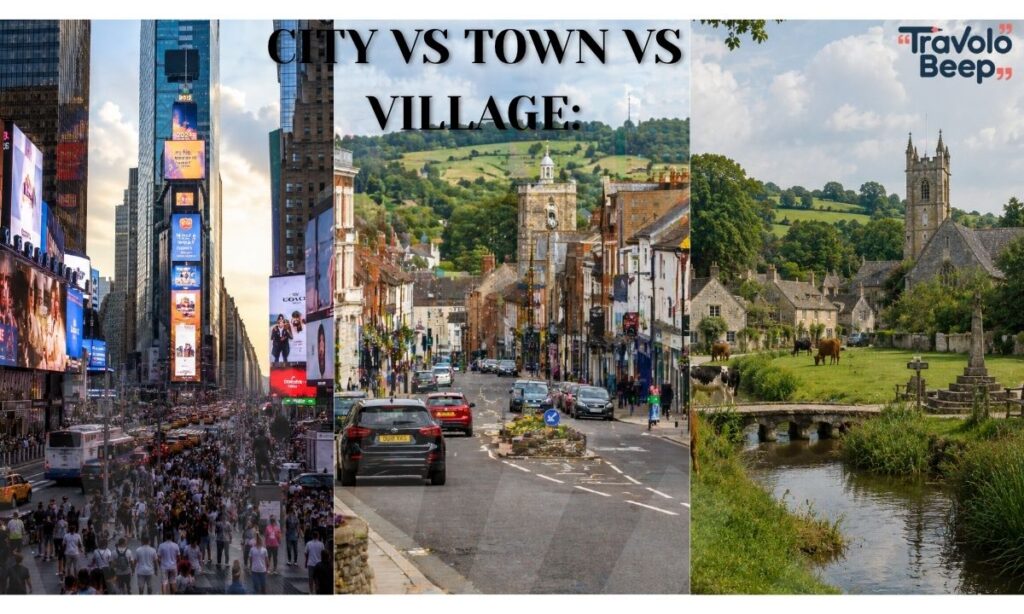
Visualizing Settlement Hierarchy: City vs Town vs Village
| Feature | Village | Town | City |
| Typical Population (UK) | Under 7,500 | 7,500 to 224,999 | 225,000+ (or by charter) |
| Typical Population (US) | Varies by state | Varies by state | Often 10,000 to 50,000+ |
| Legal Status | Usually none | Incorporated or unincorporated | Charter or state designation |
| Governance | Parish council or none | Town council, mayor | City council, mayor, multiple departments |
| Economy | Agricultural or residential | Mixed: retail, services, light industry | Diverse: finance, industry, healthcare, education |
| Infrastructure | Basic roads, limited services | Paved roads, schools, hospitals | Airports, metro systems, universities |
| Social Life | Close-knit, slow-paced | Community-oriented, moderate pace | Diverse, fast-paced, anonymous |
| UK Defining Feature | Parish church | Market charter (historically) | Royal charter or cathedral |
| US Defining Feature | Unincorporated area | Varies by state | Incorporated municipality |
Regional Variations
Settlement terminology shifts significantly across English-speaking regions. British English maintains the strictest informal distinctions. A “village” in England implies a rural character, a visible church, and a population unlikely to exceed a few thousand. A “town” suggests market history. A “city” implies either size or a royal charter.
American English blurs these boundaries considerably. The phrase “small town” covers an enormous range, from 500-person farming communities to 50,000-person suburban centers. The term “city” can describe anything from a 2,000-person incorporated municipality in rural Wyoming to New York’s eight million. Americans also use “downtown” for the commercial center of any settlement, regardless of whether it technically qualifies as a city.
Australian English has largely discarded formal distinctions in everyday speech. Canadians follow a somewhat stricter population threshold model but still vary significantly by province.
Common Mistakes and Classification Errors
Assuming size determines legal status. It does not, especially in the UK. Always verify official status separately from population data.
Applying one country’s rules globally. A Japanese city requires 50,000 residents. A UK city might have 1,600. These are not contradictions. They are different systems.
Calling unincorporated communities “towns.” In US usage, “town” often implies legal incorporation. Calling an unincorporated community a town in a legal or planning document may misrepresent its governance status.
Confusing borough with neighborhood. In New York City, a borough is a large administrative division with its own government offices. In England, a borough is a town with specific historical status. In everyday speech, people sometimes use “borough” loosely to mean neighborhood, which can create serious confusion in formal writing.
Treating “village” as interchangeable with “rural area.” A village is a specific type of settlement. Rural areas include farmland, nature reserves, and isolated dwellings that do not constitute any settlement at all.
Practical Tips and Field Notes
When I Corrected a Journalist’s Settlement Error
During an editorial review of a travel piece on Wales, a writer had described St Davids as “a charming little village perched on the Pembrokeshire coast.” Every adjective was fair. The destination is charming. It is small. It is coastal. But St Davids is, by official royal designation, a city. The article was making a policy argument about UK city investment funding, and the mislabeling undermined its credibility with any reader familiar with UK city status history.
The fix was straightforward: “the UK’s smallest city by population.” That one phrase preserved the charm implied by the original description while adding accuracy and, frankly, making the subject far more interesting to readers.
The lesson is this: when writing about settlements in an official or editorial context, verify the formal classification independently of what the place looks or feels like.
Memory Aids for Quick Decisions
When you need to classify a settlement quickly and cannot check formal records, these three heuristics work as rough guides, particularly for UK and historical European contexts:
Charter or cathedral? Call it a city. If a settlement holds a royal charter or an active cathedral, city is almost certainly the appropriate term historically, even if the population is small.
Market but no cathedral? Town is your word. Traditional towns earned their status through market charters. If a settlement has a long commercial history with a recognizable town center but no cathedral, town fits.
Fields outnumber streets? Village is safest. When agriculture dominates the surrounding landscape and the settlement lacks a commercial core, village is the least likely to cause offense or error.
These are not foolproof rules. Japan, Germany, France, and Australia all operate on different models. But as mental shortcuts for British English in particular, they save time and prevent the most common classification errors.
The Lifecycle of a Settlement: From Village to City
Understanding how a place moves through the settlement hierarchy adds another dimension to this topic. Settlements do not stay static. They evolve over time as population grows, economic activity shifts, and governance structures are formalized or dissolved.
The historical arc usually follows a recognizable pattern. Most of the world’s major cities began as small agricultural villages. The emergence of surplus food production around 10,000 BCE allowed some people to stop farming and take up crafts, trade, and administration. Villages with advantageous locations near rivers, trade routes, or fertile land gradually attracted more residents and became towns. Towns that developed strong political authority, religious significance, or economic dominance over surrounding areas eventually grew into cities.
Ancient Rome followed this path, beginning as a cluster of villages on the hills above the Tiber before absorbing surrounding settlements and becoming a city of over one million at its imperial peak. Medieval London started as a Roman trading post, then became a walled town, and eventually grew into the primate city of England.
The reverse can also happen. Cities decline, shrink, and sometimes lose their formal status. Rochester in Kent held city status for centuries, supported by having the second oldest cathedral in England. During a local government reorganization, it lost that designation and became a town within the Medway administrative district. The cathedral remains. The city status does not.
In the modern period, the drivers of settlement promotion have changed. Today, a village in China may become a town within a decade if it lands a manufacturing facility or tech park. A post-industrial town in the American Midwest may lose residents steadily until it functionally resembles a village, even if its legal designation remains unchanged. Economic geography now shapes settlement character faster than administrative reclassification can follow.
How Services Define the Settlement More Than Labels Do
Urban planners increasingly argue that what a settlement offers its residents matters far more than what it is called. A village with a reliable broadband connection, a well-staffed health clinic, and a good secondary school functions at a quality of life level that many official towns cannot match. A city with crumbling infrastructure and inadequate public transit may offer less to its residents than a well-managed market town.
This functional approach to settlement hierarchy was formalized in Germany through Walter Christaller’s Central Place Theory in the 1930s. Christaller argued that settlements exist in a hierarchy based on the services and functions they offer to surrounding areas, not merely on their size. A small city that serves as the regional hub for healthcare, education, and commerce holds a higher place in the functional hierarchy than a larger settlement that lacks those services. This framework influenced urban planning across Europe and remains a foundational concept in economic geography today.
The practical implication for everyday classification is this: when you are trying to understand what a settlement actually is, look at what it does as much as what it is called. Does it have a hospital? A university? A train station connecting it to a larger network? A weekly market drawing people from surrounding rural areas? These functional markers reveal settlement type in ways that population counts and legal labels sometimes obscure.
Conclusion
City, town, and village are not simply points on a size scale. They are labels shaped by medieval law, royal decree, agricultural history, local politics, and cultural convention. A place earns its classification through legal charter, population thresholds, governance structure, or simply historical habit, and which of those factors matters most depends entirely on where in the world you are standing. The smartest approach is to treat these words as jurisdiction-specific rather than universal, verify formal status before using them in official writing, and enjoy the rich, occasionally absurd complexity they carry every time a 1,600-person Welsh cathedral town officially outranks a 300,000-person English urban center.