
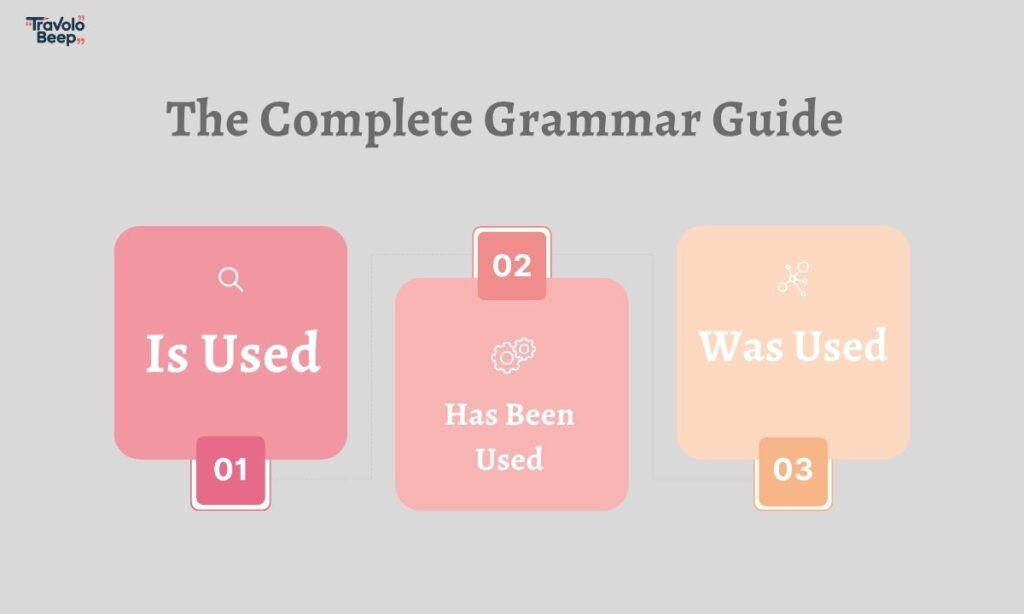

Three passive voice forms. One past participle. Yet each phrase tells a completely different story about time, relevance, and meaning. Writers at every level routinely mix up “is used,” “has been used,” and “was used.” A single wrong auxiliary verb shifts the entire timeline of a sentence and, in professional writing, quietly undermines your credibility.
This guide breaks all three forms down with labeled examples, side-by-side comparisons, common mistake analyses, and practical tips. By the end, you will know exactly which form fits which moment and why.
Understanding Passive Voice: The Foundation
In active voice, the subject performs the action: Scientists use this method. In passive voice, the subject receives the action: This method is used by scientists. The focus shifts from the doer to the action or thing being acted upon.
All three phrases are passive constructions built from: Auxiliary verb + past participle (used)
The auxiliary is what changes. “Is,” “has been,” and “was” each carry different grammatical information about tense and aspect, shifting the meaning even though “used” stays constant.
Passive voice is especially common in academic writing, scientific reports, journalism, and technical documentation because it keeps focus on processes and results rather than on the people performing actions.
.“For a clearer understanding of commonly confused words like this, check out this detailed guide on Minuet vs Minute: The Complete Guide to Getting It Right Every Time to sharpen your writing accuracy even further.”
Quick Reference: The Three Forms at a Glance
| Form | Tense | Meaning | Signal Words |
| is used | Present Simple Passive | Current habit, general fact, ongoing state | always, every day, now, generally, typically |
| has been used | Present Perfect Passive | Past action with present relevance or result | since, for, recently, already, so far, over the years |
| was used | Simple Past Passive | Completed action at a definite past time | yesterday, last year, in 2010, at that time, formerly |
Contextual Examples
Seeing the three forms in real sentences is the fastest way to feel the difference. Each example is labeled so you can identify the grammatical structure clearly.
“Is used” — Present Simple Passive
- This method [subject] is [auxiliary: present simple] used [past participle] in hospitals around the world [prepositional phrase]. → General, ongoing fact.
- Solar energy [subject] is used [present simple passive] to power thousands of homes [infinitive phrase]. → Current, habitual application.
“Has been used” — Present Perfect Passive
- This technology [subject] has been used [present perfect passive] since the 1990s [time marker showing duration]. → Started in the past, still relevant now.
- This technique [subject] has been used [present perfect passive] successfully in over forty clinical trials [result phrase]. → Accumulated evidence leading to a present conclusion.
“Was used” — Simple Past Passive
- That tool [subject] was used [simple past passive] during the 2008 investigation [definite past time marker]. → Completed, closed event.
- Coal [subject] was used [simple past passive] as the primary fuel source in Victorian England [historical past reference]. → A finished historical period.
Basic Passive Forms Labeled
Understanding the grammatical anatomy of each form prevents confusion at the structural level.“Is used” structure:
Subject + is/are + past participle (used)
| Part | Word | Label |
| This technique | “This technique” | Subject (noun phrase) |
| is | “is” | Auxiliary verb (present simple, third-person singular) |
| used | “used” | Past participle (main verb) |
| in schools | “in schools” | Prepositional phrase (adverbial modifier) |
“Has been used” structure:
Subject + has/have + been + past participle (used)
| Part | Word | Label |
| The system | “The system” | Subject (noun phrase) |
| has | “has” | Primary auxiliary (present perfect marker) |
| been | “been” | Secondary auxiliary (passive voice marker) |
| used | “used” | Past participle (main verb) |
| for decades | “for decades” | Prepositional phrase (duration marker) |
“Was used” structure:
Subject + was/were + past participle (used)
| Part | Word | Label |
| The device | “The device” | Subject (noun phrase) |
| was | “was” | Auxiliary verb (simple past, third-person singular) |
| used | “used” | Past participle (main verb) |
| in the experiment | “in the experiment” | Prepositional phrase (adverbial modifier) |
Active/Passive Comparisons With Labels
Switching between active and passive voice helps you see what each construction emphasizes.
| Active Voice | Passive Form | What Changes |
| Doctors use this drug daily. [Active: Present Simple] | This drug is used daily by doctors. [Passive: Present Simple] | Focus shifts from doctors to the drug |
| Researchers have used this model since 2015. [Active: Present Perfect] | This model has been used since 2015. [Passive: Present Perfect] | Agent (“researchers”) is dropped; result emphasized |
| Engineers used that blueprint last year. [Active: Simple Past] | That blueprint was used last year by engineers. [Passive: Simple Past] | Focus shifts to the blueprint; past event completed |
The passive form is not weaker — it is purposefully different. When the agent is unknown, unimportant, or deliberately withheld, passive voice is the more precise choice.
Questions and Negatives With Labels
Passive constructions follow standard auxiliary verb rules when forming questions and negatives.
Questions:
| Statement | Question Form | Tense Label |
| This tool is used widely. | Is this tool used widely? | Present Simple Passive Question |
| The method has been used before. | Has the method been used before? | Present Perfect Passive Question |
| That process was used in the trial. | Was that process used in the trial? | Simple Past Passive Question |
Negatives:
| Statement | Negative Form | Tense Label |
| This approach is used in surgery. | This approach is not used in surgery. | Present Simple Passive Negative |
| The protocol has been used recently. | The protocol has not been used recently. | Present Perfect Passive Negative |
| The bridge was used for transit. | The bridge was not used for transit. | Simple Past Passive Negative |
The auxiliary verb carries the negation — “is not,” “has not been,” “was not” — while “used” stays unchanged.
Time Markers and Meaning Checks
Time markers are your most reliable editing tool. They signal which passive form belongs in a sentence.
Time markers that pair with “is used”:
- every day, always, generally, typically, currently, now, in most cases, as a rule
Example: This software is used every day by thousands of small businesses.
Time markers that pair with “has been used”:
- since [year], for [duration], recently, already, so far, over the years, up to now, throughout history, in recent decades
Example: This approach has been used for over fifty years in environmental science.
Time markers that pair with “was used”:
- yesterday, last week, last year, in [specific year], at that time, formerly, in the past, during [event], before [event]
Example: That technique was used extensively during the Cold War.
Meaning Check — Ask yourself three questions:
- Is this action a current habit or general truth? → Use is used
- Did this happen in the past but still connect to the present? → Use has been used
- Did this happen at a specific, finished point in time? → Use was used
Common Mistakes
Mistake 1 — Wrong Auxiliary With Tense
Writers sometimes mix auxiliaries and tenses, producing hybrid forms that are grammatically incorrect.
| Wrong | Correct | Why |
| The process was been used effectively. | The process has been used effectively. | “Was been” is not a valid English construction. Present perfect passive requires “has/have been.” |
| The tool is been used since 2018. | The tool has been used since 2018. | “Since” signals present perfect, not present simple. “Is been” is incorrect. |
Mistake 2 — Confusing Present Simple Passive With Present Perfect Passive
This is the most common error. Both involve present-tense auxiliaries, but they describe different relationships with time.
| Wrong | Correct | Why |
| This method is used for twenty years. | This method has been used for twenty years. | “For twenty years” signals duration from past to present — that is present perfect territory. |
| This tool has been used every day in schools. | This tool is used every day in schools. | “Every day” signals habitual present — present simple passive is correct. |
Mistake 3 — Using Was Used For Present Relevance
When a past action still has current significance, “was used” closes the door prematurely.
| Wrong | Correct | Why |
| This vaccine was used in many countries and is still saving lives. | This vaccine has been used in many countries and is still saving lives. | The action began in the past and continues to be relevant. Present perfect connects the timeline correctly. |
Mistake 4 — Subject–Verb Agreement Errors With Is/Has/Was
Auxiliary verbs must agree with the subject in number and person.
| Wrong | Correct | Why |
| The results has been used to inform policy. | The results have been used to inform policy. | “Results” is plural — requires “have been,” not “has been.” |
| The data were used carefully. (when referring to data as a single set) | The data was used carefully. | In American English, “data” is often treated as singular in informal and professional writing. |
| Each of the tools are used daily. | Each of the tools is used daily. | “Each” is singular — requires singular “is.” |
Mistake 5 — Omitted Agent or Time Marker That Changes Meaning
Passive voice can create ambiguity when it leaves out information that the reader genuinely needs.
| Ambiguous | Clearer | Why |
| The report was used. | The report was used by the committee during the 2023 review. | Without agent or time marker, the reader has no context. |
| This drug is used. | This drug is used to treat Type 2 diabetes in adults. | The purpose clause eliminates ambiguity and gives the passive sentence a clear function. |
American vs British English Differences

Core Grammar Is the Same
The grammatical rules for “is used,” “has been used,” and “was used” are identical in American and British English. Both dialects form present simple passive with “is/are + past participle,” present perfect passive with “has/have + been + past participle,” and simple past passive with “was/were + past participle.”
Subtle Preference in Style Guides
The meaningful difference between the two varieties lies in how readily speakers reach for the present perfect in everyday speech. British English favors the present perfect more in conversational contexts where American English might use the simple past. A British speaker might say “The report has been submitted” where an American would say “The report was submitted.”
In formal written English — academic papers, legal documents, technical reports — both dialects follow the same conventions. If your audience is mixed or international, default to the form that most accurately reflects the time relationship you intend.
Use in Reporting and Journalism
Passive voice in journalism deserves its own discussion because it is used deliberately, strategically, and sometimes problematically.
News writers reach for passive constructions when the agent is unknown: “A device was found near the station.” They use passive forms when the event matters more than who caused it: “Three amendments were passed in Thursday’s session.” And they use passive to maintain objectivity: “A statement has been issued by the office.”
The present perfect passive appears frequently in breaking news to connect recent events to current conditions. “A state of emergency has been declared” signals that the action is recent and its effects are live. Simple past passive anchors events in a closed timeframe and is common in historical reporting and follow-up coverage.
The risk is that passive constructions can obscure accountability. “Mistakes were made” became a famous political cliché precisely because it strips the sentence of an agent, allowing the speaker to acknowledge error without assigning responsibility. Aware writers recognize this and choose passive or active voice deliberately rather than by default.
Pronunciation and Pacing
In spoken English, the three forms carry different rhythmic weights. “Is used” is quick and declarative. “Has been used” carries a sense of accumulated time. “Was used” lands with a falling tone that signals closure. Reading your sentences aloud lets you hear whether the tense feels right, and that auditory signal is often your fastest grammar check.
Idiomatic Expressions
Common Passive Idioms With Labels
English contains a number of fixed expressions and idioms that use these passive constructions. Distinguishing them from literal passive uses prevents significant confusion.
“Used to” + infinitive — past habit (not passive)
She used to walk to school. [Label: “used to” = past habit marker, NOT passive voice]
This construction describes a past habit or state that no longer exists. The structure is: subject + used to + base form of verb. It has nothing to do with passive voice despite containing “used.”
“Is used to” + gerund or noun — present familiarity (not standard passive)
He is used to working long hours. [Label: “is used to” = familiarity/acclimatization, NOT present simple passive]
This means “he is accustomed to.” The word “to” here is a preposition, not an infinitive marker, which is why it takes a gerund or noun, not a base verb.
“Was used to” + gerund — past familiarity (not simple past passive)
She was used to cold winters. [Label: “was used to” = past acclimatization, NOT simple past passive of “use”]
The safest rule: if “used” is followed by “to + gerund/noun,” you are reading an idiom, not a passive construction.
Verbs Often Found With These Passives
Some verbs appear together with passive “used” constructions so regularly that they form familiar collocations.
| Phrase | Context |
| is used to describe | Academic and technical writing |
| is used to measure | Scientific methodology |
| has been used to treat | Medical and clinical writing |
| has been used as evidence | Legal and investigative contexts |
| was used to justify | Historical and political analysis |
| was used in the construction of | Engineering and historical writing |
Practical Tips
Tip 1 — Ask What You Mean: Present Habit, Recent Use, Or Past Event?
Before writing, identify your meaning. Stating a current, ongoing fact? Choose “is used.” Pointing to something that happened in the past but still matters now? Choose “has been used.” Describing a finished, historical event? Choose “was used.” Labeling your intention first saves editing time.
Tip 2 — Check For Time Markers That Force A Tense
Time markers are your fastest grammar check. “Yesterday,” “in 2005,” and “last year” call for “was used.” “Since,” “for [duration],” and “recently” call for “has been used.” “Every day,” “always,” and “generally” call for “is used.”
Tip 3 — Label The Parts Of Speech To Avoid Mistakes
When in doubt, parse the sentence. Identify the subject, auxiliary, and past participle. Check whether the auxiliary agrees with the subject in number and whether the tense matches your intended time meaning.
Tip 4 — Watch For Idioms With “Used To”
Every time you write “used to,” pause and ask: is this passive voice or an idiom? If “to” is followed by a gerund or noun, it is an idiom expressing habit or familiarity, not passive voice.
Tip 5 — Choose Active Voice When Clearer
Passive voice exists for good reasons, but it should not be the default. When the agent of the action matters and is known, active voice is usually sharper. “The research team used this method” is stronger than “This method was used by the research team” when the team is your point.
Tip 6 — Use Present Perfect Passive To Emphasize Present Result
“Has been used” is powerful in persuasive writing and grant proposals because it connects a history of use to a current conclusion. “This ingredient has been used in clinical practice for over thirty years” makes a stronger credibility claim than “This ingredient was used in clinical practice” since the present perfect implies ongoing validation.
Tip 7 — Avoid Redundant Agents With Passive Auxiliaries
Adding an agent phrase with “by” is correct, but it can become wordy if the agent is already implied. “The form was submitted by the applicant” is fine when needed, but if context already makes clear who submitted it, “The form was submitted” is crisper.
Tip 8 — Check Agreement Carefully With Collective Nouns
Collective nouns like “team,” “committee,” and “data” can trip up agreement. In American English, collective nouns are typically singular: “The committee has been used as a reference point.” In British English they often take plural verbs: “The committee have been informed.” Know your audience and apply the convention consistently.
Tip 9 — Read Aloud To Hear Tense and Aspect Fit
Your ear catches tense mismatches that your eye skips. “Was used” closes the action. “Has been used” keeps it connected to now. “Is used” describes the present. If the sound does not match your meaning, adjust the auxiliary.
Tip 10 — Edit For Economy And Clarity
Passive constructions can become wordy in chains. Review any sentence containing two or more passives and consider whether one could turn active. “The drug was tested and was found to be effective” tightens to “Testing confirmed the drug’s effectiveness” when the actor is not the point.
Revision Examples and Fixes
Example: Wrong Time Marker With Present Perfect
Before (incorrect): This technique has been used in last year’s study.
Problem: “Last year” is a definite past time marker. Present perfect cannot anchor to a specific past time.
After (correct): This technique was used in last year’s study.
Or, preserving present relevance: This technique, which has been used across multiple studies, appeared in last year’s report.
Example: Subject–Verb Agreement
Before (incorrect): The findings has been used to support the new policy.
Problem: “Findings” is plural. Use “have,” not “has.”
After (correct): The findings have been used to support the new policy.
Example: Active Voice Replacement
Before (passive, wordy): The data was collected, analyzed, and was then used by the team to draw conclusions.
After (active, tighter): The team collected and analyzed the data, then drew conclusions from it.
The active version is substantially shorter and more direct without losing any meaning.
Conclusion
“Is used,” “has been used,” and “was used” are not interchangeable. Each places your sentence in a different time relationship, and the wrong form misleads readers even when they cannot articulate exactly why. “Is used” speaks to the present; “has been used” bridges past and present; “was used” closes a finished chapter.
Master the time markers, label your auxiliaries when in doubt, watch for idioms that look like passives, and read your sentences aloud. Those four habits resolve the vast majority of errors writers make with these three constructions. Precise grammar is not about following rules for their own sake — it is about saying exactly what you mean, the first time, without making your reader do extra work.