

Have you ever paused mid sentence, unsure whether to call your neighborhood a village or a subdivision? You are not alone. These two words show up constantly in real estate listings, casual conversations, and even legal documents, yet most people use them interchangeably without realizing they describe completely different types of communities.
A village and a subdivision might both refer to a group of houses where people live and interact, but that is where the similarity ends. One term describes a place shaped by history, culture, and organic growth. The other describes a place shaped by blueprints, developers, and modern planning. Mixing them up is an easy mistake, but it can lead to confusion in writing, real estate conversations, and everyday communication.
This confusion is understandable. Both words describe residential communities, both can appear in property listings, and both can host anything from a handful of families to several thousand residents. Yet the moment you look past the surface, the two concepts pull in opposite directions. A village tells a story of gradual settlement, shared history, and organic growth. A subdivision tells a story of engineering, market demand, and deliberate design. Knowing which story applies to a given place changes how you describe it, how you understand its governance, and even how you set expectations about daily life there.
In this guide, we will break down exactly what separates a village from a subdivision. You will learn clear definitions, correct sentence usage, common mistakes people make, and the exceptions that make this topic more interesting than it first appears. We will also walk through practical examples, a detailed comparison table, and a short set of practice exercises so the difference truly sticks. By the end, you will never second guess yourself again when choosing between these two words.
Define Village
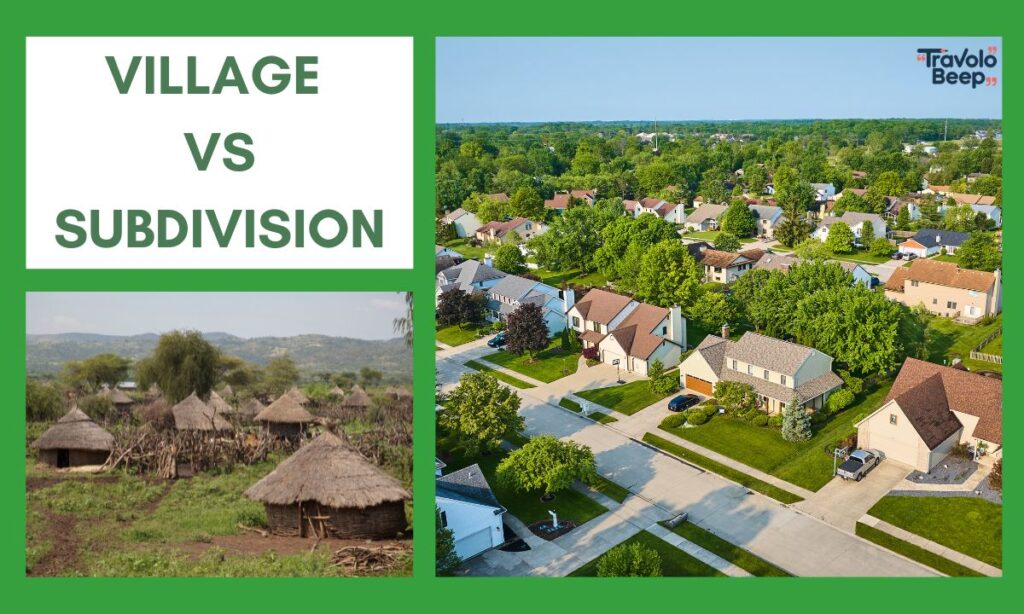
A village is a small, close-knit community that typically forms in a rural or semi-rural setting. Unlike planned developments, villages usually grow organically over generations as families settle, build homes, and establish shared traditions. A village often has its own informal or formal governance, a central gathering spot such as a town square or market, and a population small enough that most residents recognize one another.
Villages are deeply tied to culture and history. Many carry centuries of tradition, from harvest festivals to local crafts passed down through families. Life in a village tends to move at a slower pace, with agriculture, fishing, or small trade often forming the backbone of the local economy. Because villages evolve naturally rather than being designed on paper, their layout can feel irregular, with winding roads and homes built wherever the land allowed.
In many parts of the world, a village also carries legal weight. It can be a recognized administrative unit with its own council, elected leaders, or local officials responsible for basic services. This governance structure sets it apart from a simple neighborhood or cluster of houses, since a village often has defined boundaries and some level of self administration, even if that administration is informal in smaller settlements. Not every village looks identical either. Some remain purely agricultural, while others have slowly absorbed nearby suburban growth and now blend rural charm with modern conveniences, all while keeping their original village identity.
Define Subdivision
A subdivision, on the other hand, is a residential development created when a developer purchases a large piece of land and divides it into smaller lots for housing. Everything about a subdivision is intentional. Streets are mapped out before a single house is built, utilities are installed according to a master plan, and homes often follow similar architectural styles because they are constructed within the same building phase.
Subdivisions are common in urban and suburban areas where population growth demands organized housing solutions. They typically include amenities such as parks, sidewalks, community centers, and sometimes a homeowners association that enforces rules about property appearance and shared spaces. Unlike a village, a subdivision does not have its own independent government. It falls under the authority of the city, county, or municipality where it is located.
Subdivisions also tend to appear quickly compared to villages. A developer might complete an entire phase of fifty or a hundred homes within a single construction season, whereas a village takes shape gradually across decades or even centuries. This speed of construction is why subdivisions often feel uniform, with similar rooflines, matching fences, and streets that follow a clear grid pattern rather than the winding paths typical of older settlements. In many regions, a subdivision must also comply with strict zoning codes, environmental reviews, and infrastructure requirements before construction can even begin, which adds another layer of formal planning that villages simply never went through.
How To Properly Use The Words In A Sentence
Choosing the right word comes down to understanding what each term actually represents. Village refers to a naturally formed rural community with historical or cultural roots. Subdivision refers to a planned housing development created by dividing land into individual lots. Once you internalize that distinction, using each word correctly becomes second nature.
The table below offers a quick side by side comparison to help cement the difference before we look at example sentences.
| Feature | Village | Subdivision |
|---|---|---|
| Origin | Grows naturally over time | Planned and built by developers |
| Location | Rural or semi-rural areas | Urban or suburban areas |
| Governance | May have local or informal leadership | Falls under city or county jurisdiction |
| Layout | Irregular, shaped by geography | Structured, with mapped streets and lots |
| Lifestyle | Traditional, community focused | Modern, convenience focused |
| Population | Usually small and stable | Can vary widely, often growing |
| Amenities | Limited, often informal | Parks, sidewalks, HOAs, shared facilities |
How To Use “Village” In A Sentence
Use the word village when you are describing a small, traditional settlement that developed naturally, especially one located in the countryside or a rural region. It fits contexts involving heritage, agriculture, close community ties, or long standing local customs.
Here is a simple sentence that demonstrates correct usage: The village sits quietly at the base of the hills, surrounded by farmland that has supported local families for generations. Notice how the sentence highlights nature, longevity, and community, three qualities that define a true village.
How To Use “Subdivision” In A Sentence
Use the word subdivision when referring to a planned residential area created through intentional land division, usually featuring modern housing and organized infrastructure. It fits contexts involving developers, new construction, or suburban living.
A correct example sentence would be: The new subdivision on the edge of town features paved roads, matching rooftops, and a community park built for young families. This sentence emphasizes structure, planning, and modern convenience, which are the hallmarks of a subdivision.
More Examples Of Village & Subdivision Used In Sentences
Seeing these words in multiple contexts helps reinforce the difference and makes it easier to apply the correct term in your own writing or conversations. Below are several examples for each word, ranging from casual descriptions to more formal usage.
Examples Of Using Village In A Sentence
- My grandparents have lived in the same village for over sixty years, watching it change very little over time.
- Every autumn, the village hosts a harvest celebration that draws visitors from nearby towns.
- The fishing village along the coast relies almost entirely on the sea for its livelihood.
- Narrow cobblestone paths wind through the old village, connecting homes that have stood for centuries.
- She described her childhood in a mountain village where everyone knew each other by name.
- The village elder plays an important role in settling local disputes and organizing community events.
- Tourists often visit the village to admire its preserved architecture and slower pace of life.
- Farming remains the main source of income for most families in the village.
Examples Of Using Subdivision In A Sentence
- The developer broke ground on a new subdivision featuring over two hundred single family homes.
- Their subdivision includes a shared pool, a fitness center, and a small playground for children.
- Traffic near the subdivision has increased since construction of the additional housing phase began.
- The homeowners association in the subdivision requires residents to maintain their lawns and exteriors.
- We toured three different subdivisions before choosing the one closest to the highway.
- The subdivision was built in phases, with the final section completed just last year.
- Streetlights and sidewalks were installed throughout the subdivision before residents moved in.
- Many young families are drawn to the subdivision because of its modern layout and nearby schools.
Common Mistakes To Avoid

Even confident English speakers occasionally mix up these terms, especially since both describe places where people live in community. Understanding why these mistakes happen can help you avoid them in your own writing and conversations.
Mistake #1: Using “Village” To Describe A Subdivision
One of the most frequent errors is calling a modern housing development a village simply because it feels friendly or close knit. Developers sometimes encourage this by naming their projects things like Green Valley Village or Meadow Village to evoke warmth and tradition. However, if the community was designed on paper, built in phases, and lacks independent local governance or historical roots, it remains a subdivision regardless of its name. Calling it a village misrepresents its true nature and can mislead anyone trying to understand the area.
Mistake #2: Using “Subdivision” To Describe A Village
The opposite mistake also happens, though less often. Someone might refer to a small rural community as a subdivision simply because it has organized housing or a neighborhood feel. This overlooks the fact that villages grow organically and often carry cultural or historical significance that a subdivision simply does not possess. Describing a genuine village as a subdivision strips away the heritage and organic character that make it unique.
Tips To Avoid Making These Mistakes
- Ask whether the community grew naturally over time or was designed by a developer.
- Check whether the area has independent local governance or falls under a larger municipality.
- Consider the housing style. Uniform homes built in phases usually signal a subdivision.
- Look for signs of cultural or historical depth, such as long standing traditions or preserved buildings, which point toward a village.
- Remember that marketing names do not always reflect the legal or structural reality of a place.
If you find yourself stuck between the two terms, a quick mental test can help. Ask yourself whether the community would still exist in its current form if you removed the developer from the picture entirely. A village would still exist, because it grew from the land and the people who settled there. A subdivision would not exist, because it depends entirely on a planned construction project. This simple thought exercise clears up most of the confusion in just a few seconds.
Village Vs Subdivision At A Glance
Before moving into context and exceptions, it helps to summarize the practical takeaways in one place. Keep these points in mind whenever you are unsure which word to use.
- A village grows over time, while a subdivision is built according to a plan.
- A village often has informal or formal local governance, while a subdivision answers to a larger municipality.
- A village tends to sit in a rural or semi-rural area, while a subdivision usually sits in or near a city.
- A village reflects tradition and heritage, while a subdivision reflects modern convenience and structure.
- A marketing name that includes the word village does not automatically make a place a true village.
Context Matters

Beyond definitions and grammar rules, real world context plays a huge role in determining which word fits best. Three factors in particular, location, lifestyle, and personal preferences, often influence how people choose between village and subdivision.
Location
Geography is one of the clearest indicators. A community surrounded by farmland, forests, or open countryside strongly suggests a village, especially if it developed gradually without formal planning. A community situated within or near a city, featuring paved streets and modern infrastructure, is far more likely to be a subdivision. That said, regional development patterns vary, so it helps to look beyond location alone when making a final judgment.
Lifestyle
The pace and style of daily life also matters. Villages typically offer a slower, more traditional lifestyle centered around agriculture, local trade, or long standing customs. Subdivisions usually cater to residents seeking convenience, modern amenities, and proximity to urban jobs and services. If someone describes daily routines involving tending crops, attending local festivals, or walking to a small market, village is likely the correct term. If someone mentions commuting to a nearby city, using a shared gym, or following homeowners association rules, subdivision fits better.
Personal Preferences
Finally, personal values shape how people choose where to live and which word they use to describe it. Those who value history, tight community bonds, and a quieter pace often gravitate toward villages. Those who prioritize modern conveniences, structured neighborhoods, and access to urban amenities tend to prefer subdivisions. Neither lifestyle is better than the other. They simply cater to different priorities, and the terminology should reflect that distinction accurately.
It also helps to think about long term goals. Someone planning to raise a family close to relatives in a rural hometown will likely describe that setting as a village, especially if the community has existed for generations. Someone relocating for a new job in a growing metropolitan area will more often end up choosing a subdivision, since these developments are usually built specifically to accommodate newcomers and rapid population growth. Recognizing your own priorities, whether that means slower living or modern convenience, makes it much easier to pick the right word and the right home.
Exceptions To The Rules
Language is rarely perfectly tidy, and the village versus subdivision distinction has its share of exceptions. These special cases explain why some communities blur the line between the two categories.
1. Historical Villages
Some villages retain their name even after growing significantly larger than a typical village population. Because these places carry deep cultural and historical importance, residents and officials continue calling them villages despite their expanded size. Preserved buildings, long standing traditions, and generational roots keep the village identity intact even as the population increases. In many cases, a historical village may technically function like a small town in terms of population and services, yet locals and historians continue to use the original name out of respect for its heritage and founding story.
2. Planned Villages
In some cases, developers create a planned community and intentionally label it a village to evoke warmth and tradition, even though it was designed and built like any other development. These planned villages may include curated town squares or community events meant to mimic traditional village life, but structurally they function more like a subdivision with a carefully chosen name. Retirement communities are a common example, since many advertise themselves as villages to emphasize a friendly, walkable atmosphere, even though every home, road, and amenity was mapped out long before the first resident arrived.
3. Unincorporated Subdivisions
An unincorporated subdivision exists outside official city or town boundaries, with county authorities managing services like road maintenance and public safety. Even though residents may experience a strong neighborhood feel, the area does not qualify as a village because it lacks independent local governance. Legal classification depends on incorporation status rather than community atmosphere. Residents of these areas sometimes petition for incorporation later on, hoping to gain more control over local services and taxation, but until that process is complete, the subdivision remains under county authority rather than becoming a self governing village.
4. Regional Differences
Usage of these terms can vary significantly depending on the region or country. In some places, any small residential community might casually be called a village, even if it technically functions as a housing development within a larger city. In other regions, strict legal definitions govern which term applies, and officials use these classifications for zoning, taxation, and administrative purposes. Always consider local conventions before assuming a universal rule applies.
For example, in certain parts of the United States, a village is a specific type of incorporated municipality, smaller than a city but still recognized as a self governing entity with its own elected officials and municipal services. In other countries, the word village carries no legal meaning at all and simply describes any small rural settlement, regardless of formal recognition. Meanwhile, the word subdivision can refer strictly to the act of dividing land in some jurisdictions, while in everyday conversation it almost always refers to the finished residential neighborhood itself. Because of these regional quirks, it is always worth checking local usage before assuming your understanding of the term applies everywhere.
Practice Exercises
Testing your understanding is one of the best ways to make these definitions stick. Try the exercises below and see how confidently you can apply the correct term.
Exercise 1: Fill In The Blank
- My aunt lives in a small _______ surrounded by rice fields and quiet dirt roads.
- The developer just finished the third phase of the new _______ near the highway.
- Every summer, the _______ celebrates its founding with a traditional festival.
- Their home is located in a gated _______ with a shared swimming pool and clubhouse.
- The fishing _______ has relied on the same harbor for over two hundred years.
Answers: 1. village, 2. subdivision, 3. village, 4. subdivision, 5. village
Exercise 2: Identify The Correct Word
Read each description and decide whether it describes a village or a subdivision.
- A community built in three phases with matching brick homes and a homeowners association.
- A settlement of a few hundred people who farm the surrounding land and gather at a weekly market.
- A neighborhood with curved streets, a shared park, and streetlights installed before residents moved in.
- A centuries old settlement known for its preserved stone buildings and annual harvest celebration.
Answers: 1. subdivision, 2. village, 3. subdivision, 4. village
If you answered most of these correctly, you now have a solid grasp of how to separate a naturally grown community from a planned residential development. Revisit the comparison table whenever you feel unsure, since the core signals of origin, location, governance, and lifestyle rarely change from one example to the next.
You can also checkout this article as well Challenge or Challange: Which Is Actually Right? (Updated 2026)
Conclusion
A village and a subdivision may both describe places where people live and build community, but their origins, structure, and character set them clearly apart. A village grows naturally, carries cultural weight, and often reflects generations of tradition. A subdivision is deliberately planned, built in phases, and designed for modern convenience. Keeping location, lifestyle, and governance in mind will help you choose the right word every time, whether you are writing, discussing real estate, or simply describing where you call home. The next time you hear either term, you will know exactly which story it tells.