
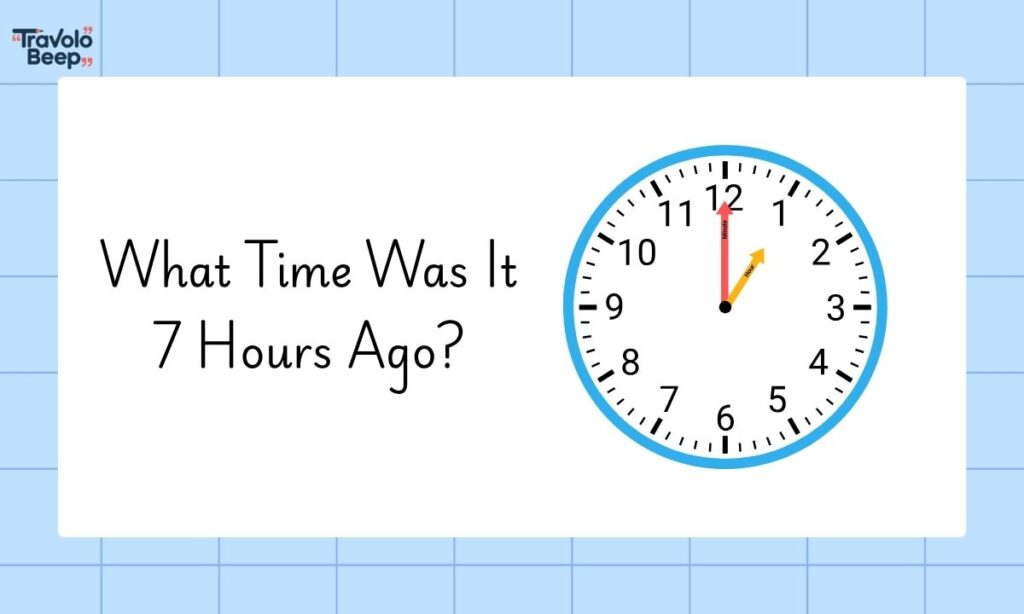

Figuring out what time it was seven hours ago sounds like a small question, but it comes up more often than most people expect. Maybe you are checking when a file was uploaded, reviewing a work shift, or trying to make sense of a timestamp on a message. Whatever the reason, the good news is that the math behind it is simple once you understand the pattern. This guide walks through exactly how to calculate the time seven hours ago, why the question matters, and how different tools and devices handle it for you automatically.
What Time Was It 7 Hours Ago?
To find out what time it was seven hours ago, you simply take the current time and subtract seven hours from it. For example, if it is currently 3:00 PM, then seven hours earlier it was 8:00 AM. If it is currently 9:00 AM, then seven hours earlier it was 2:00 AM the same day.
The calculation stays the same no matter where you are in the world, as long as you are working with a single time zone. The only part that trips people up is when the subtraction crosses midnight, which we will break down in detail further in this article.
Here is a quick reference table showing how the seven hour subtraction works from a few common starting points:
| Current Time | Time 7 Hours Ago |
|---|---|
| 12:00 AM | 5:00 PM (previous day) |
| 3:00 AM | 8:00 PM (previous day) |
| 7:00 AM | 12:00 AM |
| 10:00 AM | 3:00 AM |
| 1:00 PM | 6:00 AM |
| 6:00 PM | 11:00 AM |
| 11:00 PM | 4:00 PM |
Once you get comfortable with this pattern, calculating any number of hours ago becomes second nature.
Understanding the Simple Time Calculation
At its core, calculating a time seven hours ago is basic arithmetic on a twenty four hour cycle. Clocks repeat every twenty four hours, so any subtraction that goes below zero simply wraps around to the previous day, starting again from twenty three.
Here is the general method broken into steps:
- Note the current hour, using the twenty four hour format if possible to avoid AM and PM confusion.
- Subtract seven from that hour.
- If the result is zero or a positive number, that is your answer for the current day.
- If the result is negative, add twenty four to it, and remember the day shifts back by one.
For instance, if the current time is 4:00 (in twenty four hour format), subtracting seven gives negative three. Adding twenty four brings that to twenty one, which is 9:00 PM the day before. This same logic works whether you are calculating by hand, using a calculator app, or writing a script.
Why People Search “What Time Was It 7 Hours Ago”
This question shows up in daily life far more often than people realize. Some of the most common reasons include:
- Trying to match a notification timestamp with something that happened earlier
- Reviewing when a payment, order, or delivery was processed
- Checking work logs or attendance records
- Verifying when a social media post, comment, or message was sent
- Coordinating with someone in a different time zone
- Reconstructing a timeline after an incident or system error
In most of these situations, people are not looking for a lesson in time math. They just want a fast, accurate answer, which is exactly why time calculators and built in device tools have become so popular.
What Time Was It 7 Hours Ago Across Midnight?
The trickiest part of this calculation happens when subtracting seven hours pushes the result into the previous day. This is where a lot of manual mistakes happen, especially when people forget that the date changes along with the time.
Consider this example. If the current time is 2:00 AM, subtracting seven hours does not give you a negative clock reading. Instead, it rolls back to 7:00 PM the day before. The hour changes, and so does the calendar date.
A simple way to check yourself is to ask two questions:
- Is the current hour, in twenty four hour format, less than seven?
- If yes, then the resulting time belongs to the previous day.
This rule applies consistently, whether you are working with a digital clock, a spreadsheet formula, or a paper calendar. Getting the date right is just as important as getting the hour right, especially for logs, invoices, and scheduling records where the date carries legal or financial weight.
What Time Was It 7 Hours Ago Using AM and PM
Twelve hour clocks add a layer of complexity because of the AM and PM labels. Here is how the logic works when using this format:
- If the current time is in the morning and subtracting seven hours does not go below 1:00, the result stays in AM.
- If the current time is in the morning and the subtraction goes below 1:00, add twelve to the hour and switch the label to PM, since the result falls on the previous evening.
- If the current time is in the afternoon or evening and subtracting seven keeps the hour at 1:00 or above, the result stays in PM.
- If the current time is in the afternoon or evening and the subtraction drops below 1:00, add twelve and switch the label to AM.
A practical example makes this clearer. If it is currently 5:00 AM, subtracting seven hours brings the hour count into negative territory in raw form, so you add twelve and switch to PM, landing on 10:00 PM the previous day. On the other hand, if it is currently 6:00 PM, subtracting seven gives 11:00 AM the same day, since the hour stays positive and the period naturally flips from PM to AM.
Devices That Can Calculate 7 Hours Ago Instantly

Manual calculation is useful to understand, but most people rely on devices to do this instantly. Common tools include:
- Smartphones with built in clock and calculator apps
- Laptop and desktop operating systems with system clocks
- Smartwatches that sync with connected phones
- Voice assistants that respond to spoken time questions
- Browser based search engines that show live results
Each of these devices pulls the current time from either a local system clock or a synced network time source, then applies the same subtraction logic described earlier. The advantage is speed and accuracy, since the device handles date rollovers and AM and PM conversions automatically.
Using an Online Time Calculator
An online time calculator is often the fastest and most reliable way to check a time seven hours in the past. These tools typically ask for a starting time, or automatically detect your current time, and then let you subtract any number of hours, minutes, or even days.
The main benefits of using a dedicated calculator include:
- No manual math required
- Automatic handling of midnight and date changes
- Support for different time zones
- Instant results without needing to open a separate app
Most of these calculators also let you flip the calculation around, so you can check what time it will be a certain number of hours from now, which is useful for scheduling future events.
How Browsers Handle Time Calculations
Modern web browsers are built with internal time functions that make calculations like this possible behind the scenes. When you visit a time calculator website, the browser reads your device’s local time settings and time zone, then performs the subtraction using standardized time libraries.
This is why the same website can show different results to different visitors, depending on where they are located and how their device clock is set. Browsers also account for daylight saving time changes automatically in most regions, which matters if the seven hour window happens to cross a clock change date.
Real-Time Calculations on Different Devices
Real time updates are one of the most useful features of modern time tools. Instead of showing a static result, many calculators refresh automatically as the actual clock moves forward.
Here is how a few common devices compare when it comes to real time accuracy:
| Device Type | Time Source | Update Frequency |
|---|---|---|
| Smartphone | Network synced clock | Continuous |
| Desktop computer | System clock, often internet synced | Continuous |
| Smartwatch | Synced with paired phone | Continuous |
| Basic digital clock | Internal battery powered clock | May drift over time |
| Online calculator website | Device or server time | Refreshes on load or interval |
Devices that stay connected to the internet tend to be the most accurate, since they regularly sync with global time servers rather than relying on an internal clock that can drift.
Practical Examples of Seven Hours Earlier
Seeing how this calculation applies to real situations makes it easier to understand why it matters.
Checking an Upload
If a file shows it was uploaded at 11:00 PM, knowing that seven hours earlier was 4:00 PM helps you match it against other activity logs from that afternoon, such as when a project was finalized or shared with a team.
Reviewing Work Hours
If a shift ended at 6:00 PM, subtracting seven hours shows that the shift likely started around 11:00 AM, which is useful when verifying scheduled hours against actual clock in and clock out records.
Looking at Delivery Records
If a package shows a delivery confirmation at 2:00 PM, checking seven hours earlier, 7:00 AM, can help confirm when the package left the local distribution center that same morning.
Social Media Posts
If a post was published at 10:00 AM, seven hours earlier was 3:00 AM, which might explain why it received little engagement right away, since most followers were likely asleep during that early window.
Time Difference and Time Tracking
Understanding a seven hour gap is also closely related to broader time tracking and time zone concepts. Businesses that operate across regions often deal with gaps of five, seven, or even twelve hours between offices or team members.
Knowing how to quickly calculate a seven hour difference helps with:
- Scheduling meetings that work across regions
- Tracking when remote employees actually completed tasks
- Understanding server logs that record activity in a different time zone than the viewer
- Coordinating shipping and logistics between distant locations
Time tracking software often builds this kind of subtraction directly into reports, converting raw timestamps into a format that matches the viewer’s local time automatically.
Why Exact Timestamps Matter
Precision matters more than people often assume. A timestamp that is off by even a few minutes, let alone a full hour, can create confusion in situations such as:
- Financial transactions, where exact timing can affect processing order
- Legal or compliance records, where timestamps may be used as evidence
- Customer support logs, where response times are measured
- Security systems, where knowing exactly when an event occurred can help identify a cause
Because of this, relying on accurate, synced clocks and reliable time calculators is not just a convenience. It is often a necessity for maintaining trustworthy records.
Common Mistakes When Calculating Seven Hours Ago
Even though the math is simple, a few common errors show up again and again.
Forgetting Midnight
Many people subtract seven hours without checking whether the result crosses into the previous day, leading to a correct hour but an incorrect date.
Ignoring Time Zones
Comparing timestamps from two different time zones without converting them first can create a gap that looks like seven hours but is actually something else entirely once time zones are aligned.
Confusing AM and PM
Switching AM and PM incorrectly during twelve hour clock subtraction is one of the most frequent mistakes, especially when the calculation crosses the noon or midnight mark.
Using the Wrong Device Clock
A device with an incorrect internal clock setting, whether it is a few minutes off or set to the wrong time zone, will throw off every calculation based on it, even if the subtraction method itself is correct.
What Time Was It 7 Hours Ago in Different Situations
The importance of this calculation shifts slightly depending on the context it is used in.
Log Analysis
System administrators often subtract hours from an alert timestamp to trace back through server logs and identify what triggered an issue.
Event Tracking
Analysts reviewing user behavior on websites or apps frequently check what happened a set number of hours before a spike or drop in activity.
Delivery Monitoring
Logistics teams compare pickup and delivery timestamps, often needing to know what was happening seven hours earlier at a warehouse or distribution hub.
Social Platforms
Content creators sometimes review posting times against engagement data, checking what time zone and hour their audience was most active seven hours before or after a post went live.
Work Schedules
Payroll and scheduling teams use this kind of subtraction to confirm shift start times, break periods, and overtime calculations.
Benefits of an Automatic Time Calculator
While manual calculation is a useful skill, automatic tools offer clear advantages for everyday use:
- Speed, since results appear instantly without manual steps
- Accuracy, since the tool handles date changes and AM and PM shifts correctly
- Convenience, since most calculators work directly in a browser without installation
- Flexibility, since many tools allow adjusting the number of hours, not just seven
- Time zone support, which removes the guesswork when comparing locations
For anyone who deals with timestamps regularly, whether for work, scheduling, or personal tracking, an automatic calculator removes the small but real risk of human error.
Understanding Time Arithmetic
Time arithmetic follows a base twenty four system rather than the base ten system most people are used to for everyday math. This is why subtraction can feel unusual at first, since going below zero does not simply produce a negative number, it wraps back around to twenty three.
The same logic applies to minutes and seconds within an hour, both of which follow a base sixty system. Once this wrapping behavior is understood, calculating any number of hours ago or from now, not just seven, becomes far more intuitive.
You can also checkout this article as well How Long Until 3:00 PM?
Final Thoughts
Calculating what time it was seven hours ago is a simple skill once you understand how clocks wrap around midnight and how AM and PM shift during subtraction. Whether you work it out by hand or rely on a device or online calculator, the goal is the same: getting an accurate answer quickly. With the steps and examples covered here, you now have everything needed to calculate it confidently, anytime the question comes up.