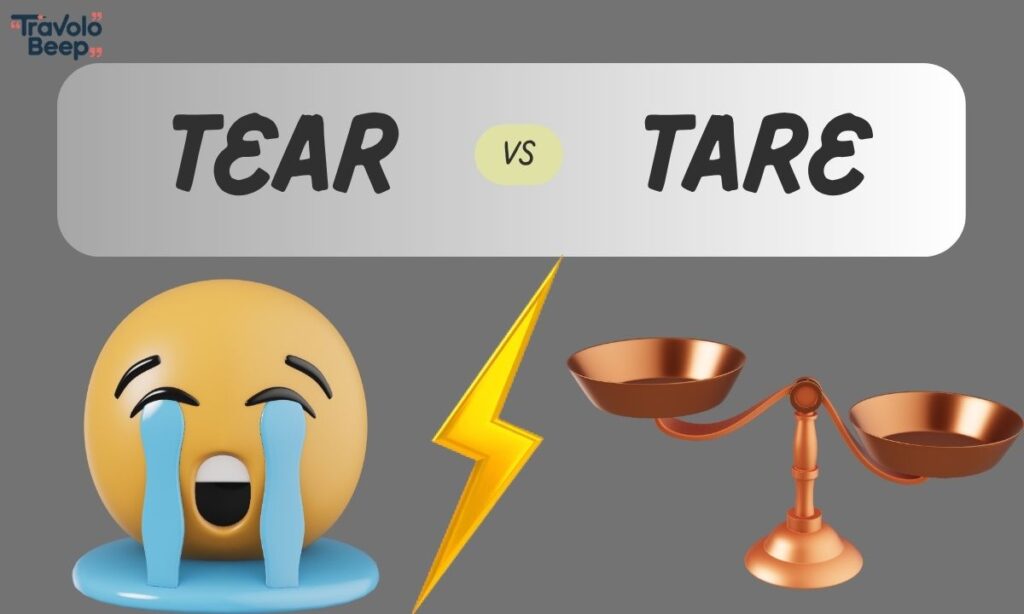

If you’ve ever second-guessed yourself mid-sentence typing “tare” when you meant “tear,” or the other way around you’re not alone. These two words are among the trickiest homophones in the English language. They sound absolutely identical when spoken aloud, yet they belong to completely different worlds of meaning. One describes the act of ripping something apart. The other is a technical term used in shipping, commerce, and science.
This guide covers everything: definitions, etymology, usage examples, common mistakes, memory tricks, and much more. By the time you finish reading, you’ll never mix them up again.
Why Do These Identical-Sounding Words Confuse People?
Homophones trip up even native English speakers, but tear and tare present a particularly tricky case. Most homophones share at least some loose thematic connection “there,” “their,” and “they’re” all orbit around location or possession. But tear and tare? They have zero meaningful overlap.
The confusion deepens because “tear” itself carries two completely different pronunciations depending on its meaning:
| Word | Pronunciation | Meaning |
| Tear (rip) | /tɛr/ — rhymes with air, bear, care | To pull apart by force; a rip or hole |
| Tear (eye drop) | /tɪər/ — rhymes with ear, fear, near | A drop of saline fluid from the eye |
| Tare | /tɛr/ — rhymes with air, bear, care | The weight of an empty container |
So when you read the word “tear” in text, your brain must figure out which meaning applies before it can even assign a pronunciation. And when you hear the sound /tɛr/ spoken aloud, your brain has to choose between “tear” (the rip) and “tare” (the container weight) two words that look different but sound completely alike.
That’s a lot of cognitive juggling for a four-letter word.
Add to that the fact that “tare” almost never appears in casual conversation, so most people encounter it only in specialized contexts logistics, chemistry, cooking scales and the confusion is understandable.
Where Did Tear and Tare Come From?
Understanding the word histories of tear and tare helps explain why they sound the same despite meaning such different things. These words didn’t start out as related terms that drifted apart over time. They arrived in English through entirely separate historical journeys one through the ancient Germanic world, the other through medieval Arabic trade routes.
The Germanic Path: How Tear Evolved
The word tear in both its “rip” and “eye drop” senses traces back through Old English to Proto-Germanic and beyond.
Tear meaning “to rip” comes from the Old English word teran, which meant “to pull apart by force” or “to lacerate.” This Old English word descended from the Proto-Germanic root *teraną, which in turn connects to the Proto-Indo-European root *der-, meaning “to split or flay.” This ancient root is remarkably productive it gave rise to similar words across many Germanic languages. German developed zehren (“to consume”), Dutch produced teren (“to eliminate”), and Gothic had ga-tairan (“to destroy”). The meaning of forceful separation runs consistently through all of them.
Tear meaning “eye drop” followed a different but equally old Germanic path. It descends from Old English tēar, which came from Proto-West Germanic *tahr, itself from the Proto-Indo-European root *dáḱru- (“tears”). The same ancient root influenced Latin lacrima the origin of the English word “lacrimose,” meaning tearful and even Irish deoir and Welsh deigr.
Interestingly, “tare” briefly existed as the past tense of the ripping verb “tear” in very old English, but it was replaced by “tore” around the 17th century. This historical quirk is partly why the confusion between tear and tare has a genuine linguistic basis they once had a grammatical relationship.
The Arabic Journey: How Tare Arrived
The word tare (container weight) took a completely different route into English, arriving through medieval trade networks that connected the Arab world to Europe.
The journey begins with the Arabic word ṭarḥah (طَرْحَة), meaning “that which is thrown away” or “something rejected” derived from the Arabic verb ṭaraḥa (“to throw away or reject”). The logic is elegant: when you weigh goods in a container, the container’s weight is the part you throw away or don’t count. It’s the irrelevant portion, the part subtracted to get the true measurement.
From Arabic, the word passed into Medieval Latin as tara, then into Old Italian as tara, then into Middle French as tare. By the late 15th century first recorded in English around 1480–90 it had entered English as a commercial and trade term. One of its earliest written appearances in English occurs in the naval inventories of Britain’s King Henry VII, which recorded two barrels of gunpowder weighing, “besides the tare,” 500 pounds.
The word “tare” (as a type of weed or plant) has a separate, older origin appearing in English around 1300 from uncertain Germanic roots but this meaning is rarely encountered outside of biblical or botanical contexts today.
How Do You Use Tear vs Tare in Different Contexts?
Now for the practical heart of the matter. The correct word to use depends entirely on your context.
Everyday Writing with Tear
In everyday writing, tear is by far the more common of the two words. It functions as both a noun and a verb, and it covers physical damage, emotional expression, and rapid movement.
As a verb (to rip):
- Please don’t tear the wrapping paper I want to save it.
- She tore open the envelope and pulled out the letter.
- The dog managed to tear apart his new toy within minutes.
- He tore his shirt getting through the barbed wire fence.
As a noun (a rip or hole):
- There was a small tear in the knee of his jeans.
- The fabric had a long tear running along the seam.
- Even a tiny tear in the sail could cause problems in high winds.
As a noun (eye drop):
- A single tear slid down her cheek when she heard the news.
- His eyes filled with tears as he said goodbye.
- She blinked back a tear and tried to smile.
As a verb (to cry):
- His eyes teared up at the sight of his childhood home.
- She found herself tearing up during the documentary.
As a noun (a rampage — American English):
- The team went on a tear, winning seven games in a row.
- He was on a tear at the poker table, taking everyone’s chips.
Technical Writing with Tare
Tare belongs primarily to professional, commercial, and scientific writing. If your sentence involves weighing goods, calculating net weight, or adjusting a scale, “tare” is almost certainly the correct word.
Understanding the three key weights:
| Term | Definition | Example |
| Gross Weight | Total weight (container + contents) | 12 kg |
| Tare Weight | Weight of the empty container alone | 2 kg |
| Net Weight | Weight of contents only | 10 kg |
As a noun:
- The shipping manifest listed the tare as 4.5 kilograms.
- Subtract the tare from the gross weight to find the net weight.
- The tare of this container is clearly stamped on the side.
- The tare weight of the truck must be recorded at the weigh station.
As a verb (to zero out a scale):
- Press the button to tare the scale before adding your ingredients.
- She tared the container first so the reading would reflect only the product.
- Always tare your laboratory flask before adding reagents.
In botany (less common):
- The field was overrun with tares growing among the wheat.
- The parable speaks of tares sown among good seed a metaphor for hidden corruption.
When Context Makes It Obvious
In most real-world writing, context removes all ambiguity. If you’re writing a shipping invoice, “tare” is clearly correct. If you’re writing a scene in a novel where a character rips open a letter, “tear” is obviously the right choice. The only genuine risk of confusion arises in handwriting or quick typing, where the brain auto-completes the wrong spelling.
Examples of Tear in Classic Literature

Famous Uses in Old Books
Classic authors reached for “tear” frequently, both in its physical ripping sense and its emotional eye-drop meaning. The word’s versatility made it indispensable to storytelling.
William Shakespeare used “tear” repeatedly across his plays and sonnets to convey grief, violence, and emotional intensity. In Othello (1603), tears mark moments of manipulation and genuine sorrow. In King Lear, the act of tearing clothing, relationships, kingdoms serves as a central metaphor for destruction.
Charles Dickens employed “tear” in A Tale of Two Cities (1859) to dramatize both physical destruction garments torn in grief, paper torn in desperation and the emotional weight of sacrifice during the French Revolution.
Mark Twain used “tear” naturally in dialogue throughout The Adventures of Tom Sawyer (1876) and Adventures of Huckleberry Finn (1884), capturing the way ordinary Americans spoke about damage, mischief, and sorrow.
The King James Bible, published in 1611, contains numerous uses of both “tear” (to rip) and “tears” (eye drops), as well as “tares” (the weed), making it one of the earliest English texts where all senses of these words appear in close proximity.
Modern Business and Technical Writing
In modern professional contexts, “tare” appears routinely across several industries:
- Logistics and shipping: Freight documents, bills of lading, and customs declarations list tare weights for containers, trucks, and railcars.
- Food industry: Grocery scales and food production equipment include a tare function to weigh contents without counting the packaging.
- Scientific laboratories: Analytical balances feature a tare button so researchers can weigh reagents without counting the mass of the flask or beaker.
- Automotive and transportation: Vehicle registration documents in many countries record the tare (unladen) weight alongside gross vehicle weight rating (GVWR).
- Agriculture: Farmers and commodity traders use tare weight to determine the true yield of grain or produce after subtracting container weight.
What Words Mean the Same as Tear vs Tare?
Knowing synonyms helps you avoid repetition in your writing and confirms that you’ve selected the right word to begin with.
Words Related to Tear
Synonyms for tear (to rip / a rip):
| Word | Usage | Nuance |
| Rip | “She ripped the paper” | Slightly more violent or sudden |
| Rend | “The explosion rent the air” | Formal or literary; old-fashioned |
| Split | “The wood split along the grain” | Implies separation along a line |
| Shred | “He shredded the documents” | Tearing into many small pieces |
| Lacerate | “The fall lacerated his arm” | Medical or formal; implies ragged edges |
| Slit | “She slit the envelope open” | A clean, directed cut or tear |
| Rupture | “The membrane ruptured” | Suggests something bursting open |
Synonyms for tear (eye drop):
- Teardrop — the physical drop of fluid
- Sob — when crying involves sound
- Weep — a more formal or literary word for crying
- Lacrimation — the medical/clinical term for tear production
Words Related to Tare
Synonyms and related terms for tare (container weight):
| Term | Context |
| Empty weight | General usage for vehicles and containers |
| Unladen weight | Vehicles; especially trucks and railway cars |
| Dead weight | The weight of the vessel itself, minus load |
| Net weight | The weight of contents only (opposite concept to tare) |
| Gross weight | Total weight including contents and container |
| Tare weight | The full compound form; most formal usage |
Understanding these related terms helps you write more precisely in technical documents and confirms that “tare” belongs in the weight-and-measurement family of vocabulary.
Visualizing the Differences
Here’s a quick-reference comparison to settle the tear vs tare question at a glance:
| Feature | Tear | Tare |
| Pronunciation | /tɛr/ (rip) or /tɪər/ (cry) | /tɛr/ (same as “rip” tear) |
| Part of speech | Noun, verb | Noun, verb |
| Primary meaning | A rip; to rip something apart | Weight of an empty container |
| Secondary meaning | A drop from the eye; to cry | A type of weed (archaic/biblical) |
| Tertiary meaning | A rampage (American English) | |
| Common contexts | Everyday writing, literature, emotions | Shipping, commerce, science, cooking |
| Frequency | Very common | Specialized/technical |
| Origin | Old English teran / tēar (Germanic) | Arabic ṭarḥah → French → English |
American and British English
One reassuring fact: there is no difference between American and British English usage for tear and tare. Both varieties of English use the same spellings and meanings for both words.
- British speakers say “tare weight” in logistics contexts just as American speakers do.
- Both British and American writers use “tear” for ripping and “tear” for eye drops.
- The grammar, spelling, and usage rules are identical on both sides of the Atlantic.
The only place regional variation might appear is in pronunciation of certain dialects. In some British dialects, vowel sounds shift, but the distinction between /tɛr/ and /tɪər/ for “tear” remains consistent across standard British and American English.
Common Mistakes When Using Tear vs Tare
Even careful writers make these errors. Recognizing them helps you catch and correct them quickly.
Mistake 1 — Using “tare” for physical ripping:
❌ Please tare the paper along the dotted line. ✅ Please tear the paper along the dotted line.
Mistake 2 — Using “tear” for container weight:
❌ Record the tear weight before loading the freight. ✅ Record the tare weight before loading the freight.
Mistake 3 — Using “tear” for the scale function:
❌ Tear the scale before adding your baking ingredients. ✅ Tare the scale before adding your baking ingredients.
Mistake 4 — Using “tare” in emotional writing:
❌ A tare ran down his cheek as he said goodbye. ✅ A tear ran down his cheek as he said goodbye.
Mistake 5 — Confusing “tare” with “tore” (past tense of tear):
❌ She tare the receipt in half. ✅ She tore the receipt in half. (Note: “Tare” was the archaic past tense of “tear” in Old English, but “tore” replaced it in the 17th century. Using “tare” as a past tense is an error in modern English.)
Mistake 6 — Misspelling in shipping documents: This one carries real financial risk. In logistics, writing “tear weight” instead of “tare weight” on a customs declaration or bill of lading can cause confusion at inspection points and delay shipments.
Practical Tips for Using Tear vs Tare Correctly
Real-World Editing Experience
Experienced editors and writers use a simple mental filter before finalizing their word choice. Ask yourself: Is this sentence about weight, measurement, or containers? If the answer is yes, write “tare.” If the sentence involves ripping, breaking, crying, or moving fast, write “tear.”
This context-first approach works because the two words almost never appear in the same type of document. You won’t find “tare” in a novel or a personal essay. You won’t find “tear” on a freight manifest or a laboratory scale protocol.
Memory Tricks That Work
Trick 1 — The “A” in tare stands for Arithmetic: Tare contains the letter sequence a-r-e. Think: “Tare is about arithmetic subtract the container weight.” When math is involved, use tare.
Trick 2 — Tare rhymes with “bare”: An empty container is bare it has nothing inside. Tare rhymes with bare. The tare weight is the weight of the bare, empty container.
Trick 3 — Tear the paper: For the ripping meaning, picture your hand physically tearing a piece of paper. The action is physical, visible, immediate. Tear goes with physical actions and emotions the stuff of stories and daily life.
Trick 4 — Tare = Trade term: Both tare and trade start with the letters t-a. Tare arrived in English specifically as a commercial trade term. If you’re doing business involving weighing goods, tare is your word.
Trick 5 — The scale button: Almost every modern digital kitchen scale, postal scale, and laboratory balance has a button labeled TARE. If you press it with an empty bowl on the scale, it zeros out the display. Next time you see that button, you’re reinforcing the correct spelling in a real-world context.
Conclusion
Tear and tare are genuine homophones words that sound identical but carry completely different meanings with separate etymological histories stretching back over a thousand years. Tear, rooted in Old English and Proto-Germanic, covers the universal human experiences of ripping, breaking, and crying. Tare, arriving through Arabic trade routes via Middle French and Medieval Latin, belongs to the precise world of weights, measurements, and commerce.
The good news is that context does most of the heavy lifting. If you’re writing about emotions, fabric, paper, or physical damage, “tear” is correct. If you’re writing about container weights, shipping logistics, laboratory measurements, or zeroing a kitchen scale, “tare” is the right choice. When you’re unsure, ask yourself the one key question: Is this sentence about weight? If yes, tare. If not, tear.“For a clearer understanding of commonly confused words like this, check out this detailed guide on input vs imput to sharpen your writing accuracy even further.”
Here’s a final quick-reference summary to bookmark:
Use TEAR when:
- Describing physical damage (a rip, a hole, a torn seam)
- Writing about the action of ripping something
- Referring to drops from the eye or the act of crying
- Describing someone moving quickly and recklessly
- Writing fiction, personal essays, poetry, or everyday prose
Use TARE when:
- Writing about container weight or empty vehicle weight
- Discussing the process of subtracting packaging weight from gross weight
- Instructing someone to zero out a scale
- Drafting shipping documents, lab protocols, or trade invoices
- Referring to the weight measurement concept in any professional context
Mastering these two words is a small investment that pays large dividends in writing clarity. Whether you’re drafting a logistics report, crafting a short story, baking a recipe with careful measurements, or simply texting a friend choosing the right word signals precision, care, and command of the language. That’s a standard every writer should hold themselves to, regardless of the audience or the subject matter.
Once you understand where these words come from and how differently they function in real-world writing, choosing the right one becomes second nature and your writing becomes sharper, more credible, and much harder to misread.
FAQs
What is the simplest way to remember tear vs tare?
If your sentence involves weight or measurement, use tare. For everything else ripping, crying, moving fast use tear.
Are tear and tare true homophones?
Yes, in their most common pronunciations (both as /tɛr/), they are perfect homophones they sound completely identical.
Can “tare” ever mean ripping?
No. In modern English, “tare” never means ripping. Historically it was an archaic past tense of “tear,” but that usage died out around the 17th century.
Is “tare weight” one word or two?
It’s two words. “Tare weight” is the standard compound noun used in shipping, logistics, and weighing contexts.
What does the TARE button on a scale do?
It resets the scale display to zero after you’ve placed an empty container on it, so the scale only measures the contents you add not the container itself.
Is there a difference between British and American English for these words?
No. Both varieties of English use “tear” and “tare” identically in spelling, meaning, and usage.
What is the plural of tare?
The plural is tares used either in the weight sense (“record all tares for the containers”) or in the botanical sense (“the fields were choked with tares”).
What is the past tense of “to tear” something?
The correct past tense is tore (e.g., “She tore the paper in half”). The past participle is torn (e.g., “The paper was torn”). The archaic “tare” should never be used as a past tense in modern writing.
Can “tare” be used as a verb?
Yes. “To tare” means to account for or zero out the container weight on a scale. Example: “Tare the flask before adding the solution.”
Where does the word “tare” appear in the Bible? “
Tares” appears in the Parable of the Tares (Matthew 13:24–30), where it refers to a weed likely darnel sown among wheat. This is a different, older meaning of “tare” than the commercial weight term.