
You’re typing fast, finishing a sentence, and suddenly you pause is it “that’s” or “thats”? It’s a small detail, but it matters more than most people realize. Whether you’re writing a professional email, a blog post, or a social media caption, getting this right separates polished writing from careless errors.
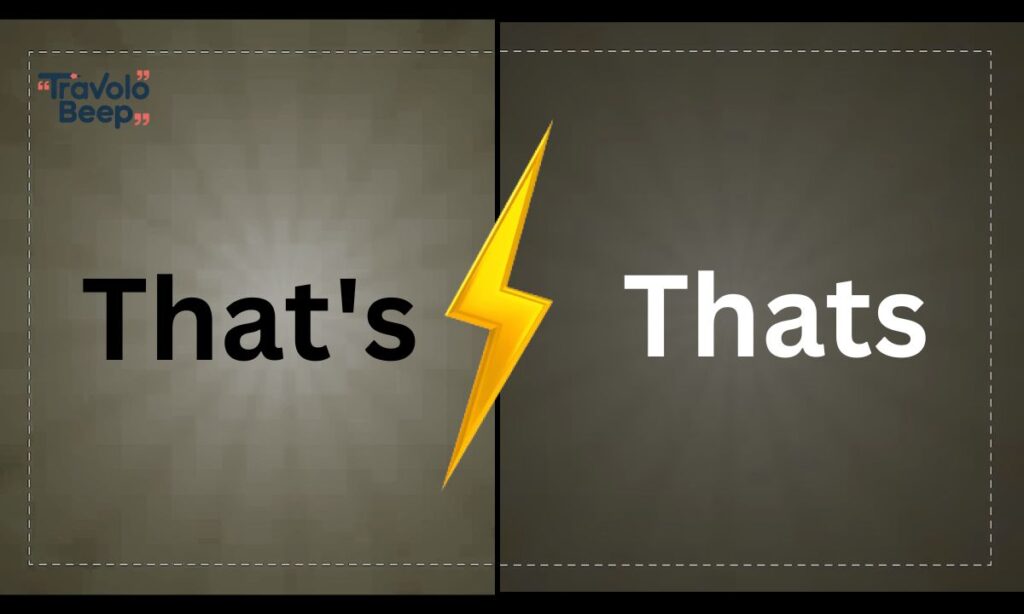
The short answer: “That’s” is always correct. “Thats” is always wrong. But understanding why will help you never second-guess it again.
What Does the Apostrophe in That’s Do?
The apostrophe in “that’s” is not decorative it has a specific grammatical job. It signals a contraction, which is a shortened form of two words merged into one.
In the case of “that’s,” the apostrophe replaces a missing letter. Specifically, it stands in for the letter “i” from the word “is” or the letters “ha” from “has.”
So “that’s” can mean one of two things, depending on context:
- That is → “That’s a great idea.” (= “That is a great idea.”)
- That has → “That’s been a long week.” (= “That has been a long week.”)
This is consistent with how all contractions work in English. Words like don’t (do + not), I’m (I + am), and she’s (she + is) all follow the same principle: an apostrophe marks exactly where letters were removed. Remove the apostrophe from “that’s” and you don’t get a simpler word you get a spelling error.
Key rule: The apostrophe in a contraction always replaces at least one missing letter. Writing “thats” without an apostrophe removes that signal entirely, leaving a word that has no recognized meaning in English.
That’s in Correct Usage
“That’s” functions as a contraction in two distinct ways. Knowing which version you’re using helps you confirm you’re on the right track.
When “That’s” Means “That Is”
This is the most common usage. “That’s” introduces a description, identification, or statement about something specific.
| Contracted Form | Expanded Form |
|---|---|
| That’s my car. | That is my car. |
| That’s exactly what I meant. | That is exactly what I meant. |
| That’s a beautiful painting. | That is a beautiful painting. |
| That’s the wrong answer. | That is the wrong answer. |
When “That’s” Means “That Has”
This version is slightly less common but equally correct. It appears most often with words like been, happened, or gone.
| Contracted Form | Expanded Form |
|---|---|
| That’s been a tough year. | That has been a tough year. |
| That’s never happened before. | That has never happened before. |
| That’s always worked for us. | That has always worked for us. |
The substitution test is your best friend here. Whenever you’re unsure, replace “that’s” with “that is” or “that has” and read the sentence aloud. If it still makes sense, you’re using the contraction correctly.
Correct Usage Examples
Below are real-world examples of “that’s” used correctly across different writing styles and contexts.
Everyday conversation:
- “That’s the best coffee I’ve had all week.”
- “I can’t believe that’s already over.”
- “That’s what she said at the meeting.”
Professional writing:
- “That’s a reasonable concern worth addressing.”
- “We believe that’s the most effective approach.”
- “That’s consistent with what the data shows.”
Academic or formal writing:
- “That’s a conclusion supported by three independent studies.”
- “That’s not a position the evidence can sustain.”
Creative writing and storytelling:
- “That’s the moment everything changed.”
- “He looked up and said, ‘That’s not how it works.'”
- “That’s been the nature of this story from the beginning.”
Notice that in every example above, “that’s” can be replaced with “that is” or “that has” without breaking the sentence’s meaning. That’s the hallmark of correct usage.
Incorrect Usage Examples
Now let’s look at what happens when the apostrophe is dropped — and why each example fails.
| Incorrect | Correct | Why It’s Wrong |
|---|---|---|
| Thats a good point. | That’s a good point. | “Thats” is not a recognized English word. |
| I think thats the answer. | I think that’s the answer. | Missing apostrophe breaks the contraction. |
| Thats been a long day. | That’s been a long day. | No apostrophe = no contraction. |
| Thats my favorite song. | That’s my favorite song. | “Thats” has no meaning in standard grammar. |
| He said thats not right. | He said that’s not right. | The missing apostrophe is a spelling error, not a style choice. |
In every case, the fix is identical: add the apostrophe. There is no scenario in standard English where “thats” without an apostrophe is acceptable.
Context Variations
Informal and Digital Writing
Texting, social media, and instant messaging are where “thats” appears most often. Fast thumbs, autocorrect failures, and casual habits lead people to drop the apostrophe without realizing it. This is understandable in a quick text but it’s still technically incorrect. If you’re building a personal brand, a professional online presence, or writing content for an audience, correct grammar builds credibility..“For a clearer understanding of commonly confused words like this, check out this detailed guide on Mine As Well, Might As Well, or Mind As Well to sharpen your writing accuracy even further.”
Formal and Academic Writing
In formal contexts, contractions like “that’s” are sometimes discouraged altogether. In those cases, write out the full form: “that is” or “that has.” This isn’t about “thats” vs “that’s” it’s about whether contractions fit the register at all.
The Honda That’s Exception
There is one genuine exception worth knowing: Honda That’s a compact car sold in Japan in the early 2000s. “Thats” appears without an apostrophe here because it’s a branded proper noun, not a grammatical construction. Brand names are allowed to bend standard spelling rules. Outside of referring to that specific vehicle, “thats” remains incorrect.
Dialogue and Fiction
In creative writing, apostrophes in contractions are essential for natural-sounding dialogue. A character saying “Thats not true” would read as a typo rather than an authentic voice. Getting contractions right in dialogue is what makes speech feel real on the page.
Common That’s Spelling Errors
Beyond the main “thats vs that’s” confusion, a few related errors appear regularly in written English.
1. Confusing “that’s” with “that” alone
“That” and “that’s” are not interchangeable. “That” is used as a demonstrative pronoun or conjunction without a linking verb.
- Incorrect: “I think that the problem.” (missing verb)
- Correct: “I think that’s the problem.” (with contraction)
- Also correct: “I think that is the problem.” (expanded form)
2. Misplacing the apostrophe
Some writers place the apostrophe in the wrong spot writing “tha’ts” or “thats'” which creates a completely different error. The apostrophe in “that’s” belongs between the t and the s, representing the missing letter i from “is.”
3. Using “thats” in professional documents
This is the highest-stakes version of the error. In a résumé, cover letter, or business report, “thats” signals inattention to detail. Spell-check won’t always catch it because some programs don’t flag it as an error. A manual read-through or a grammar tool like Grammarly will.
4. Autocorrect removing the apostrophe
Mobile keyboards are often the culprit. Many devices silently drop the apostrophe when typing quickly, turning “that’s” into “thats” without the writer noticing. Always reread before sending anything formal.
How to Remember the Apostrophe in That’s
Grammar rules stick better when you have a clear mental model. Here are a few practical ways to lock this one in.
The Squeeze Method
Think of a contraction as squeezing two words together. When you squeeze “that” and “is” into one, something has to give — the letter “i” disappears. The apostrophe is the mark left behind where that letter used to be. No squeeze, no apostrophe needed. But if you’re squeezing two words together, the apostrophe is non-negotiable.
The Substitution Test
This is the most reliable trick in practical use. Before writing “that’s” (or “thats”), try expanding it:
- Say the sentence with “that is” — does it make sense? If yes, write “that’s.”
- Say the sentence with “that has” — does it make sense? If yes, write “that’s.”
- If neither works, you probably don’t need a contraction at all.
The Credibility Check
Ask yourself: Would a typo in this spot make me look careless? In formal writing, on a website, or in an email to a client — yes, it would. Thinking about how your writing reflects on you is often all the motivation needed to slow down and add the apostrophe.
Pair it with similar contractions
“That’s” follows the exact same pattern as “he’s,” “she’s,” “it’s,” and “what’s.” If you would never write “hes” or “shes,” you should never write “thats.” Treating all these contractions consistently makes the habit automatic.
Conclusion
“Thats” is not a word it never has been, and no amount of casual usage changes that. “That’s,” with the apostrophe firmly in place, is the only correct form. It signals a contraction of “that is” or “that has,” and the apostrophe is what makes that meaning clear. Use the substitution test whenever you’re unsure, reread your writing before sending, and remember: that one small mark is the difference between a clean sentence and a careless mistake.