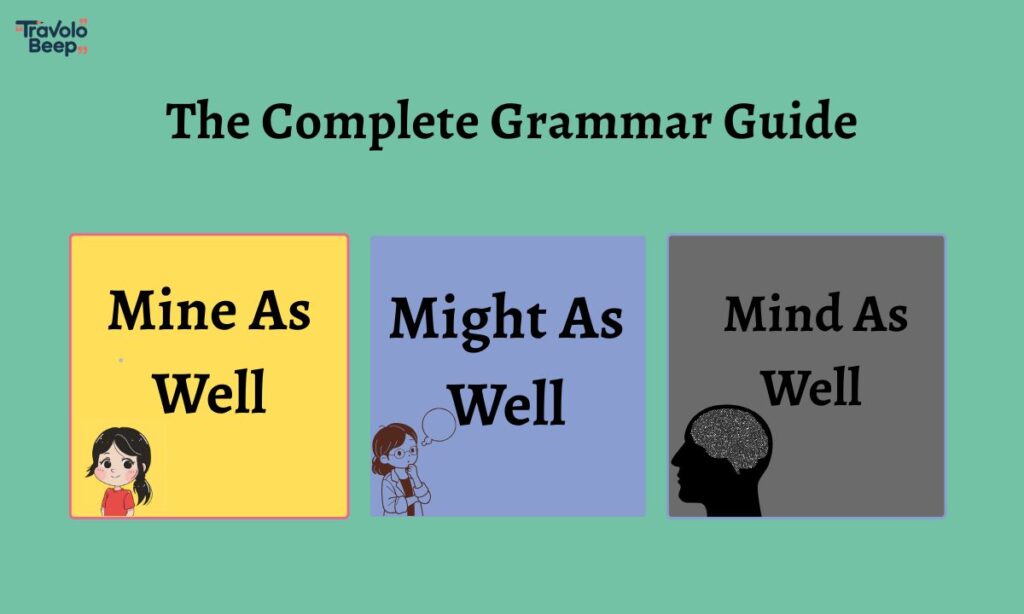

Three small words. Enormous confusion. Whether you’re a native English speaker dashing off a text message or a language learner trying to sound natural in conversation, the phrases mine as well, might as well, and mind as well have tripped you up at least once. You’re not alone even fluent speakers mishear, miswrite, and misuse these expressions every single day.
Here is the short answer before we dive deep: “Might as well” is the standard, correct idiom in English. “Mine as well” is a legitimate possessive construction but serves an entirely different grammatical purpose. “Mind as well” is almost always an error a phonetic slip caused by fast speech. Understanding why each phrase exists, what it means, and when (or whether) to use it will sharpen both your writing and your spoken English significantly.
This guide covers contextual examples, common mistakes, American vs British English differences, idiomatic expressions, and ten practical tips to help you get it right every time.
What Each Phrase Actually Means
Before exploring usage in depth, it helps to understand the grammar behind each phrase at its most basic level.
| Phrase | Part of Speech | Correct? | Core Meaning |
| Might as well | Modal verb + adverbial phrase | ✅ Yes — always | Suggests doing something when no better option exists |
| Mine as well | Possessive pronoun + adverbial phrase | ✅ Conditionally | Claims ownership alongside someone else |
| Mind as well | Verb/noun (misused) + adverbial phrase | ❌ Almost never | Nonstandard; usually a mishearing of “might as well” |
Contextual Examples
Standard Idiom: Might As Well
“Might as well” is a modal idiom composed of the modal verb might followed by as well, which functions as an adverbial intensifier. Together, they express that a particular action is logical, sensible, or worth doing simply because there’s no compelling reason not to. Think of it as saying “why not?” with a slight shrug of resignation.
Structure: Subject + might as well + base verb (bare infinitive)
- We might as well cancel the reservation the restaurant is closed.
- If the flight is delayed two hours, we might as well grab dinner.
- I’m already here, so I might as well stay for the whole meeting.
- You might as well pick up some milk while you’re at the store.
Notice that “might” is always followed by the base form of the verb never to + verb. Saying “we might as well to go” is a grammar error. The modal already carries the meaning; no infinitive marker is needed.
The phrase carries a subtle emotional note too. It often signals acceptance, a “making the best of it” attitude, or mild resignation. It’s informal enough for casual conversation but polished enough for neutral professional contexts.“For a clearer understanding of commonly confused words like this, check out this detailed guide on Tear vs Tare to sharpen your writing accuracy even further.”
Possessive: Mine As Well (Contextualized)
“Mine as well” is grammatically correct in a narrow but real set of circumstances specifically, when mine functions as a possessive pronoun substituting for a previously mentioned noun, and as well means also or too.
- That dog is mine as well. (It belongs to me, too.)
- Your idea caught on, and mine as well. (My idea also caught on.)
- Her response was loud, and mine as well. (My response was also loud.)
The key is that “mine” must have a clear antecedent a word or phrase it refers back to. Without that prior context, the sentence collapses into vagueness. In formal writing, it’s often cleaner to expand the ellipsis: “Her response was loud, and mine was too.”
Nonstandard Variant: Mind As Well
“Mind as well” is not a standard English idiom. In nearly every case, a person who says or writes mind as well means might as well they’ve simply substituted mind for might, usually because both words sound similar in quick, casual speech. The word mind is a verb meaning to pay attention or to object, or a noun referring to the intellect. Neither meaning fits the idiomatic construction here.
“We mind as well leave now” incorrect. Fix: “We might as well leave now.”
That said, mind as well appears legitimately in one narrow context: written dialogue that intentionally represents informal or dialectal speech. A fiction writer might use it to convey a character’s regional accent or colloquial patterns. When used this way, it should be clearly marked as nonstandard.
Embedded Question Forms
Sometimes “might as well” appears inside embedded questions indirect questions nested within a larger sentence. The idiom functions the same way grammatically.
- I wonder whether we might as well reschedule the meeting.
- She asked if he might as well take the early train.
- Nobody knows why we might as well bother at this point.
Notice that embedded questions follow normal word order (whether we might as well reschedule), not inverted question word order. The idiom stays intact inside the larger sentence.
Tag Along: Might As Well + Result Clause
One of the most expressive ways to use the idiom is by following it with a result clause a phrase that explains the consequence or motivation for the suggested action. This structure adds clarity and persuasive weight to the statement.
- It’s raining heavily, so we might as well cancel; there’s no point driving two hours.
- The store closes in ten minutes we might as well come back tomorrow.
- She’s already done half the work; she might as well finish the whole report.
Structure: Situation/condition → might as well + base verb → optional result clause
This pattern appears frequently in both spoken and written English because it frames a practical decision with clear reasoning.
Common Mistakes
Mistake 1: Replacing Might With Mind
The most frequent error is writing mind as well when you mean might as well. It happens because in fast speech, the t at the end of might often drops, making might sound like mine or even mind to a hurried listener.
❌ “We mind as well just call it a day.” ✅ “We might as well just call it a day.”
Quick fix: Ask yourself am I making a suggestion or expressing logical acceptance? If yes, use might. The word mind doesn’t carry modal function and cannot take the place of might in this construction.
Mistake 2: Using Mine As Well Without a Clear Antecedent
Mine as well only works when the reader already knows what mine refers to. Dropping it into a sentence without prior context leaves your audience guessing.
❌ “I could take that mine as well.” (Mine as well as what?) ✅ “I could take the extra ticket it can be mine as well.”
Or, cleaner still: “I’ll take it too.”
Mistake 3: Confusing Meaning With Merely Adding “As Well”
Adding as well to any sentence doesn’t automatically make it work. The full idiomatic meaning of might as well comes from the modal verb + the adverbial phrase together. Splitting them or rearranging them destroys the idiom.
❌ “I might go as well.” (This means “I might also go” a different meaning.) ✅ “I might as well go.” (This means “there’s no good reason not to go.”)
Mistake 4: Punctuation With Elliptical Replies
In short elliptical replies responses that drop the verb for brevity punctuation errors are common. If someone says “Nobody else wants the last slice,” a spoken reply of “Mine as well” is understood. But in writing, the omission can look abrupt or confusing.
❌ “Mine as well” (period — feels incomplete without context) ✅ “It can be mine as well.” or “That one’s mine too.”
Use a comma before as well in longer constructions: “You can take the early flight, and I might as well take it too.”
Mistake 5: Overusing the Idiom Without Consequence
Might as well implies that an action is worth taking because there’s little downside. Overusing it makes your writing feel resigned or passive rather than decisive. If you genuinely prefer an action, say so directly: “We should leave now” is stronger than “We might as well leave now.”
American vs British English Differences
Shared Core Usage
Both American and British English treat might as well as the standard, go-to idiom. The grammar is identical on both sides of the Atlantic: modal verb might + adverbial as well + bare infinitive. The phrase means the same thing in New York and in London.
Regional Variants and Informal Speech
Dialectal variants like mind as well are occasionally heard in certain British regional dialects and in some American sociolects particularly in rapid or casual speech. In both contexts, such variants are acceptable in written dialogue but should be avoided in standard prose or formal writing.
Preference for Might vs May
This is where the two dialects show a subtle but notable difference. Both might as well and may as well are correct. However:
| Variant | Dialect Preference | Register |
| Might as well | More common in American English | Casual and neutral |
| May as well | Slightly more frequent in British English | Can sound more formal or tentative |
According to Cambridge Grammar, might as well is more common overall than may as well in everyday speech. The difference is not grammatical both are correct but tonal. May as well can suggest permission (“You may as well try” = it’s allowed/fine to try), while might as well leans toward suggestion or logical inevitability.
Teaching Note
If you’re teaching English, this distinction is worth addressing. For learners using American English materials, defaulting to might as well is the safest choice. For learners in a British English context, both forms are equally valid, though may as well may appear more often in textbooks and formal writing guides.
Idiomatic Expressions
Might As Well + Infinitive Result
The most common and important form. Use it anytime you want to express that an action is sensible given the circumstances.
- The meeting was cancelled. We might as well head home.
- You’re already dressed — you might as well come along.
- She’s been working so long she might as well finish tonight.
Mine As Well as Ellipsis
Used correctly, mine as well appears in exchanges where ownership has already been established and the speaker claims equal possession.
A: “Nobody claimed the last parking spot.” B: “It’s mine as well I reserved it this morning.”
In formal writing, always expand elliptical uses to avoid ambiguity.
Mind As Well in Dialogue
Fiction writers sometimes use mind as well deliberately to capture a character’s speech pattern or dialect. When this is the intent, it’s a valid literary choice.
He shrugged and said, “We mind as well start without them.”
The dialogue tag signals the reader that this is the character’s voice, not standard grammar.
Idiom Variants With Conditionals
The idiom pairs naturally with conditional or since-clauses:
- Since we’re already at the airport, we might as well check our bags early.
- If the deadline is flexible, she might as well take a day to revise it.
- Because nobody objected, they might as well proceed.
These conditional structures add clear reasoning to the suggestion, making the idiom feel purposeful rather than passive.
Practical Tips
Tip 1: Use a Simple Substitution Test
Before writing mine as well or mind as well, try substituting might as well into the sentence. If it fits and makes sense, that’s the correct phrase. If you’re talking about ownership, mine (without the idiom framing) or mine too is likely cleaner.
Tip 2: Keep Modal Grammar Straight
After might as well, always use the base verb no to, no -ing, no past tense.
✅ We might as well go. ❌ We might as well to go / going / went.
This rule never changes, regardless of subject or tense.
Tip 3: Avoid Using Mine As Well Without Context
If there’s any chance a reader won’t know what mine refers back to, rewrite the sentence. Clear antecedents are essential for elliptical possessives. When in doubt, use mine too or restructure the sentence entirely.
Tip 4: Mark Dialogue for Nonstandard Speech
If you use mind as well in fiction or creative writing to represent a character’s dialect, signal it clearly through the narrative voice. Avoid using it in your own authorial voice, summaries, or expository passages.
Tip 5: Teach Learners the Difference With Minimal Pairs
For English language teachers, minimal pair exercises work well here. Write both sentences side by side and ask learners to identify the difference in meaning:
- “This book is mine as well.” (ownership)
- “I might as well read this book.” (suggestion)
One tests possession; the other tests modal reasoning. The contrast reinforces both meanings simultaneously.
Tip 6: Use Commas and Ellipses Properly
When might as well introduces a clause following a comma, punctuate accordingly:
- The store is closed, so we might as well try tomorrow.
- It’s been a long day we might as well call it quits.
Avoid omitting punctuation before a result clause in longer sentences, as it creates run-on constructions.
Tip 7: Don’t Overuse Idioms
Every idiom loses power when repeated too frequently. If might as well appears three times in a paragraph, replace some instances with “there’s no reason not to,” “we should probably,” or a direct assertive statement. Variety keeps writing engaging and natural.
Tip 8: Watch Register
Might as well is informal to neutral it works in casual texts, everyday conversation, and neutral professional settings. In highly formal writing legal documents, academic papers, executive reports replace it with explicit reasoning: “Given the current timeline, the most logical course of action is to…”
Tip 9: Proofread for Common Typos
Autocorrect and fast typing often swap might for mind or mine without the writer noticing. When proofreading, do a targeted search for mine as well and mind as well and verify that each instance is intentional and correct.
Tip 10: Teach Consequence Clauses
When teaching this idiom, always include the consequence or result clause in practice sentences. This trains learners to associate might as well with the full reasoning structure:
“Since X is true → we might as well Y → because Z.”
This three-part pattern reflects how the phrase naturally functions in real communication and helps learners produce it correctly rather than just recognizing it.
Frequently Asked Questions
Is “might as well” formal or informal?
It’s informal to neutral. It works in everyday conversation and standard professional writing but is too casual for formal academic or legal contexts.
Can “mine as well” ever replace “might as well”?
No. They have entirely different meanings. Use mine as well only for possession and might as well for suggestions.
Why do people say “mind as well”?
Because might and mind sound similar in fast speech, especially when the t at the end of might is dropped. It’s a mishearing, not a valid variant.
What verb form follows “might as well”?
Always the base verb (bare infinitive): go, stay, try, leave — never to go or going.
What verb form follows “might as well”?
Almost. Both are correct and mean the same thing. May as well is slightly more formal and more common in British English; might as well is more common overall.
Can I use “might as well have” to talk about the past?
Yes. Might as well have + past participle describes a past action that would have been equally sensible: “We might as well have stayed home.”
Is “mind as well” ever correct?
Only in intentional nonstandard dialogue in fiction. Never in standard prose.
What does “mine as well” need to make sense?
A clear antecedent — something previously mentioned that mine refers back to. Without it, the phrase is confusing.
Conclusion
The confusion surrounding mine as well, might as well, and mind as well is entirely understandable. English spoken at natural speed blurs word boundaries, and three words that sound nearly identical can carry three completely different grammatical functions. But the rules are actually simple once you frame them correctly.
Might as well is your default idiom for suggesting a sensible action when alternatives are limited or absent. It’s universal, correct in both American and British English, and appropriate in almost any casual or neutral setting.
Mine as well is a legitimate possessive construction — but only when mine clearly refers back to something already mentioned. Outside of that context, it’s either confusing or simply wrong.
Mind as well belongs in character dialogue when you want to represent informal or dialectal speech — and nowhere else. In standard writing and speech, it’s an error.
Master these three distinctions, apply the substitution test, mind your modal grammar, and you’ll never confuse these phrases again. And if you ever catch yourself hesitating? Just ask: “Am I making a suggestion, or am I claiming ownership?” The answer to that single question will point you to the right phrase every time.