
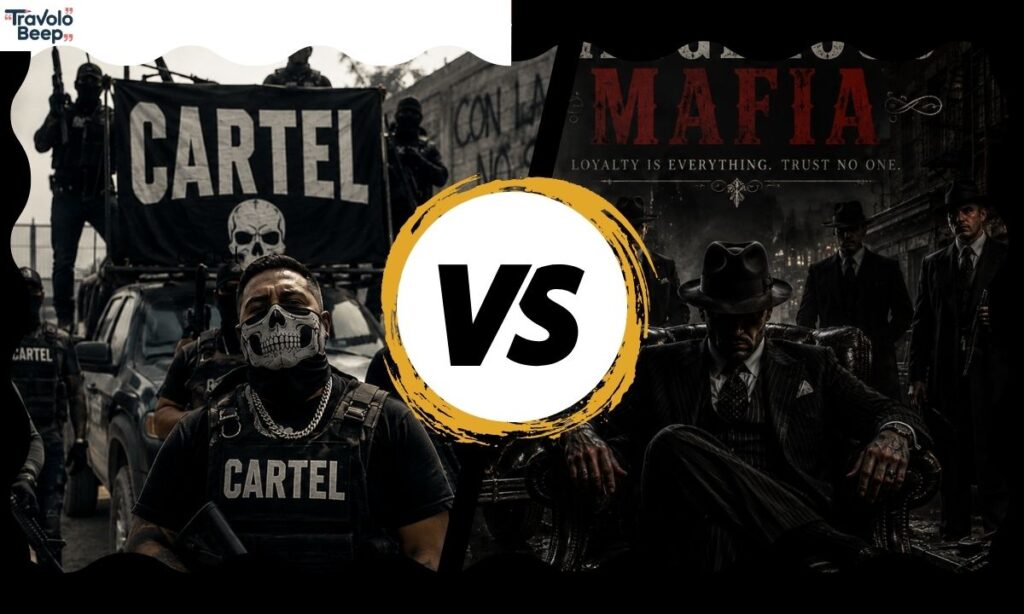

When you read the news, watch a crime documentary, or study economics, two words keep showing up cartel and mafia. Most people use them interchangeably. That is a mistake. These words come from different histories, describe different structures, and carry different meanings in law, economics, and everyday speech.
Getting them right is not just a grammar exercise. Journalists, students, lawyers, business writers, and everyday readers all need precision when using these terms. One refers to market collusion among independent groups. The other describes a tightly knit criminal organization built on loyalty and hierarchy. The difference matters whether you are writing an essay, analyzing global crime, or simply trying to understand the evening news.
This guide breaks down the cartel vs mafia distinction completely with contextual examples, grammar rules, common mistakes, figurative usage, American vs British English differences, and practical writing tips. By the end, you will know exactly when and how to use each word with confidence.
Basic Definitions
Before comparing the two, it helps to understand what each word means on its own. Both are nouns. Both describe organized groups. But their origins, purposes, and structures differ sharply.
What Is a Cartel?
A cartel is a group of independent producers, businesses, or organizations that agree to coordinate their behavior usually to control prices, divide markets, or limit competition. The word comes from the German Kartell, derived from the French cartel, which itself traces back to the Latin charta, meaning a document or letter of agreement.
In economics, a cartel exists when firms that should be competing instead cooperate to act like a monopoly. This raises prices for consumers and reduces market efficiency. The most famous legal example is OPEC (Organization of the Petroleum Exporting Countries), which coordinates oil production among member nations.
In criminal contexts, the word cartel shifted to describe drug trafficking organizations particularly in Latin America that dominate the supply, transport, and sale of narcotics. These groups function less like traditional crime families and more like multinational corporations: focused on logistics, distribution channels, and market control.
Key traits of a cartel:
- Made up of independent entities cooperating toward shared economic goals
- Can be legal (price-fixing in regulated industries) or illegal (drug trafficking)
- Primarily focused on market control and profit maximization
- More fluid and decentralized in structure than a mafia
- Originated in economic and business theory before crossing into criminal usage
What Is a Mafia?
A mafia is a structured, hierarchical criminal organization that operates through family ties, loyalty codes, and territorial control. The word originated in 19th-century Sicily, likely from the Sicilian dialect term mafiusu, meaning bold, swagger, or tough.
The original Sicilian Mafia known as Cosa Nostra (“Our Thing”) emerged during a period of political instability when the Italian state offered little protection in rural areas. Local strongmen filled that power vacuum, offering protection in exchange for money and loyalty. Over time, this informal system evolved into a structured criminal syndicate.
By the early 20th century, Italian immigrants brought these traditions to the United States, where the American Mafia flourished during Prohibition, running bootlegging operations across major cities.
Key traits of a mafia:
- Built on family or clan relationships and strict hierarchy
- Operates through a code of silence (omertà) and loyalty
- Engages in diverse criminal activities: protection rackets, extortion, gambling, loan-sharking, and political corruption
- Focused on controlling territory and communities, not just markets
- Deep cultural roots tied to specific ethnic or regional identities
Contextual Examples
Reading definitions is useful. Seeing the words used in real sentences is better. The examples below show how each term functions in different writing contexts.
Example 1 — Cartel
The Sinaloa cartel operates across multiple countries, controlling drug supply routes from production in Mexico to distribution networks in the United States and Europe.
Here, cartel functions as a noun modified by the proper adjective Sinaloa. The verb operates agrees with the singular subject. The sentence describes a criminal organization whose primary focus is market control over drug trafficking — consistent with the cartel definition.
Example 2 — Mafia
The Sicilian Mafia, or Cosa Nostra, embedded itself so deeply into Italian society that dismantling it required decades of dedicated law enforcement and judicial effort.
Mafia is a proper noun here, used with its historical Italian name. The past tense embedded signals historical narration. The sentence emphasizes territorial and societal control hallmarks of mafia behavior, not cartel behavior.
Example 3 — Cartel as Business Collusion
In 1990, several of the world’s leading auction houses were found to have formed an illegal cartel to fix commission rates, defrauding sellers of millions of dollars.
This example uses cartel in a non-drug, non-criminal-gang context. The collusion here involves legitimate businesses engaging in illegal price-fixing. This is exactly the kind of usage that confuses many writers cartel does not always mean drug lords. It refers to any group coordinating to eliminate competition.
Example 4 — Mafia as Criminal Network
The Camorra, a mafia organization based in Naples, Italy, controls large segments of the local construction industry through intimidation, corruption, and political influence.
Mafia names a specific organized crime syndicate here. The description control through intimidation and political corruption distinguishes mafia behavior from cartel behavior. Mafias typically seek power and embeddedness within communities, not just market dominance.
Example 5 — Structural Contrast in Cartel vs Mafia
While a cartel negotiates agreements across independent trafficking groups, a mafia enforces order through a single chain of command stretching from the boss to the lowest-ranked soldier.
This sentence puts both terms in direct comparison. Notice how cartel is linked to negotiation and independence, while mafia is linked to enforcement and hierarchy. The parallel structure a cartel negotiates… a mafia enforces models clean, grammatically balanced comparison.
Example 6 — Legal vs Illegal Business Sense
Economists noted that the pharmaceutical companies had formed a pricing cartel that violated antitrust law, even though none of them was a criminal organization in the traditional sense.
This example separates the economic meaning of cartel from criminal associations. The phrase none of them was a criminal organization in the traditional sense clarifies that cartel here refers to business collusion, not drug trafficking.
Quick Comparison Table
| Feature | Cartel | Mafia |
|---|---|---|
| Primary focus | Market control, profit | Territory, power, loyalty |
| Structure | Loose alliance of independents | Strict hierarchy (boss, underboss, soldiers) |
| Origins | Economics and business | Sicilian rural society, 19th century |
| Legal status | Can be legal or illegal | Always illegal |
| Key activities | Price-fixing, drug trafficking, supply chain | Extortion, racketeering, gambling, corruption |
| Code of conduct | Business agreements, contracts | Omertà (code of silence), family loyalty |
| Famous examples | Sinaloa Cartel, OPEC, Medellín Cartel | Cosa Nostra, Camorra, American Five Families |
| Geographic roots | Latin America, global markets | Sicily, Italy, Eastern Europe, US |
| Tactics | Distribution control, violence when needed | Violence, political influence, bribery |
| How they recruit | Business-style logistics operators | Family ties, ethnic or regional identity |
Common Mistakes Using Cartel vs Mafia
Even experienced writers make errors with these terms. The mistakes below appear frequently in news articles, academic writing, and everyday conversation.
Mistake 1 — Using Terms Interchangeably
Many writers treat cartel and mafia as synonyms. They are not. One is a network of cooperating independents. The other is a single unified organization with internal command. Swapping them blurs meaning and misleads readers.
Wrong: The Mexican mafia controls the cocaine trade across the border. Better: The Mexican cartel controls the cocaine trade across the border.
(Unless you specifically mean the Mexican Mafia, which is a distinct prison gang — another reason precision matters.)
Mistake 2 — Applying Business Term to Any Crime Group
Because cartel appears so often in drug crime headlines, many writers use it to describe any criminal group. This is imprecise. Not every organized crime network is a cartel.
Wrong: The local street gang formed a cartel to sell stolen goods. Better: The local street gang formed a syndicate to sell stolen goods.
Use cartel carefully. When structure is unclear, criminal organization or organized crime group is safer and more neutral.
Mistake 3 — Overgeneralizing With Single Examples
Using one example to define all cartels or all mafias leads to oversimplification. The Sinaloa Cartel is not every cartel. The Sicilian Mafia is not every mafia. The Russian Mafia, the Camorra, the Yakuza each operates differently.
Fix: Add specific context. Write the Medellín cartel or the Sicilian Mafia, not just a cartel or the mafia, when referring to specific groups.
Mistake 4 — Confusing Legal Status
Not all cartels are illegal. In certain industries and historical periods, cartel-like agreements existed within the law. The word cartel in antitrust economics refers to illegal collusion, but historically the term was applied to legitimate industry cooperatives.
Wrong: All cartels are criminal enterprises. Better: Price-fixing cartels are illegal under antitrust law, though the term historically described lawful trade agreements as well.
Mistake 5 — Misplacing Modifiers
Ambiguous modifier placement changes meaning unintentionally. Writers sometimes place adjectives in positions that create confusion about who or what is being described.
Confusing: They arrested members for illegal cartel dealings. Clear: They arrested cartel members for illegal dealings.
In the clearer version, cartel modifies members directly. In the confusing version, the reader must determine whether cartel or illegal is the intended primary modifier. Always place modifiers next to the nouns they describe.
American vs British English Differences

Both American and British English use cartel and mafia as nouns. Neither term changes spelling across varieties. However, media habits, cultural associations, and legal terminology differ significantly between the two.
Word Usage and Media Trends
In American English, cartel frequently appears in policy debates, law enforcement press releases, and news coverage of Latin American drug trafficking. The word carries a specific association with Mexican and Colombian criminal networks, driven by the War on Drugs coverage since the 1980s.
In British English, mafia appears more often in figurative speech particularly to describe perceived networks of insider power in business, politics, or sport. British journalists might write about the property mafia or the media mafia when describing exclusionary professional networks. American English does this too, but less commonly.
Spelling and Grammar: Same Forms
There are no spelling differences between American and British English for these terms. Both use:
- Cartel (noun, singular) / cartels (noun, plural)
- Mafia (noun, singular) / mafias (noun, plural) though the mafia as a collective noun is also standard
Verb agreement follows standard rules in both varieties. When cartel or mafia is the subject, match the verb to singular or plural as needed:
- The cartel operates in three countries. (singular)
- These cartels compete for the same routes. (plural)
Figurative Uses in Each Variety
American English figurative use of cartel tends to appear in technology policy and business journalism: phrases like Big Tech cartel or media cartel describe companies accused of anti-competitive behavior. The figurative meaning stays close to the original economic sense.
British English figurative use of mafia often implies insider loyalty networks rather than violence: the old boys’ mafia, the Brussels mafia, the literary mafia. These expressions signal a tight group that controls access and excludes outsiders without suggesting actual criminal activity.
Legal Terms and Enforcement
American law uses specific statutory terms:
- Antitrust law targets cartels that fix prices or divide markets (Sherman Antitrust Act)
- RICO statutes (Racketeer Influenced and Corrupt Organizations Act) target mafia-style organized crime
British law has its own framework:
- Competition and Markets Authority (CMA) handles cartel enforcement
- Serious Organised Crime Agency (SOCA) and now the National Crime Agency (NCA) handle mafia-type groups
When writing for an international audience, it is better to explain these references rather than assume readers understand country-specific legal terminology.
Idiomatic Expressions
Both cartel and mafia have moved beyond their literal meanings into figurative language. These uses appear in opinion journalism, business writing, social commentary, and everyday speech.
Cartel in Figurative Language
Price cartel An informal agreement among competitors to keep prices artificially high. This is the most literal figurative extension: The major airlines were accused of forming a price cartel on transatlantic routes.
Big Tech cartel Used to describe alleged anti-competitive coordination among major technology companies. Critics argued that the data-sharing agreement amounted to a Big Tech cartel.
Media cartel Refers to a small group of companies that dominate information channels. The proposed merger would create a media cartel with no real competition in sight.
In all these uses, cartel retains its economic core meaning coordinated market control and applies it metaphorically to industries where monopoly power is suspected.
Mafia in Figurative Language
Hollywood mafia Describes the close-knit networks of producers, agents, and studios who control access to the film industry. Breaking into the industry without connections to the Hollywood mafia is nearly impossible.
Intellectual mafia Suggests a clique of academics or thinkers who control what ideas get published or promoted. The peer review process can sometimes feel like an intellectual mafia.
Property mafia Used in British English to describe developers, planners, and local politicians whose relationships determine which projects get approved. The affordable housing crisis is partly the result of a property mafia operating behind closed doors.
In these expressions, mafia emphasizes the secretive, loyalty-based nature of the group the sense that insiders protect each other and exclude outsiders rather than violence or criminal activity.
Mixed Idioms and Collocations
Some common collocations help writers use these words naturally:
| Collocation | Example |
|---|---|
| Drug cartel | The drug cartel expanded into human trafficking. |
| Cartel member | Cartel members operated in at least five states. |
| Member of the mafia | He was suspected of being a member of the mafia. |
| Mafia boss | The mafia boss gave orders through intermediaries. |
| Price-fixing cartel | The price-fixing cartel was dismantled by regulators. |
| Cartel violence | Cartel violence disrupted trade routes near the border. |
| Mafia connections | Investigators found mafia connections within city hall. |
| Crime cartel | The crime cartel controlled the port. |
When Figurative Language Becomes Misleading
Figurative uses of cartel and mafia can mislead readers if context is unclear. Calling a group of doctors a medical mafia suggests criminality and conspiracy, even if the writer only means they form a self-protective insider group. Similarly, describing a business coalition as a cartel implies illegal behavior even when the cooperation may be lawful.
Fix: When using these terms figuratively, mark the comparison clearly. A phrase like what critics call a media cartel or what some describe as a property mafia signals that the term is being used loosely or polemically, not literally.
Practical Tips: Choosing Cartel vs Mafia
The following tips address the most common writing challenges that arise when using these terms in academic, journalistic, or professional contexts.
Tip 1 — Define Your Term Early
When your article or essay involves either word prominently, define it at or near the start. Readers bring different assumptions. A business reader may understand cartel as economic collusion. A crime reporter may assume it means drug trafficking. Setting expectations early prevents misreading.
Opening example: A cartel, in competition law, is an agreement among independent firms to fix prices or divide markets. This article uses the term in that economic sense.
Tip 2 — Use Specific Names When Possible
Vague references to the cartel or the mafia force readers to guess which group you mean. Specific names the Sinaloa Cartel, the Camorra, the Ndrangheta give your writing factual grounding and reduce ambiguity.
Vague: The cartel controlled the region. Precise: The Jalisco New Generation Cartel (CJNG) controlled the region.
Tip 3 — Check Verb Tense and Agreement
When describing historical events, use past tense. When describing ongoing behavior or general truths, use present tense.
- The Medellín Cartel collapsed after Escobar’s death in 1993. (historical — past tense)
- The Sinaloa Cartel operates across more than 50 countries. (ongoing — present tense)
- Mafias typically embed themselves in local politics. (general truth — present tense)
Match the verb number to the subject: The cartel (singular) controls… Cartels (plural) control…
Tip 4 — Avoid Sensationalism
Both words carry dramatic weight. Overusing them, or using them for effect rather than accuracy, weakens your credibility. Not every price-fixing scandal deserves the label cartel. Not every corrupt network deserves the label mafia.
Choose precision over drama. If the evidence supports the term, use it. If not, use criminal organization, organized crime group, or price-fixing agreement instead.
Tip 5 — Use Neutral Modifiers for Teaching
When teaching grammar or writing with these words as examples, use neutral modifiers that acknowledge both the criminal and economic meanings. This avoids reinforcing harmful stereotypes while still using accurate examples.
Label parts of speech: The cartel (noun) fixed (verb, past) prices (noun). This helps students spot structure without sensationalizing the content.
Tip 6 — Respect Cultural Sensitivity
Terms like mafia carry ethnic and cultural associations particularly with Italian and Italian-American communities. Using mafia carelessly to describe any tight-knit group can perpetuate ethnic stereotypes.
Similarly, using cartel to describe any Latin American criminal group flattens enormous complexity. Not all organized crime in Mexico or Colombia is cartel-related. Use accurate, specific language.
Tip 7 — Watch Prepositions
Common preposition patterns for these words:
- Member of a cartel / member of the mafia (not member in)
- Cartel in [region] — The cartel operates in northern Mexico.
- Mafia in [place] — The mafia in Sicily controls local businesses.
- Part of the cartel / affiliated with the cartel
Getting prepositions right makes writing sound natural and professional.
Tip 8 — Distinguish Legal and Illegal Uses
Always clarify whether you are using cartel in its legal (competition law) or illegal (criminal organization) sense. Readers may not assume the same context you do.
Clarification example: The OPEC cartel which coordinates oil production among member states is legal under international law, unlike the price-fixing cartels that antitrust authorities routinely prosecute.
Tip 9 — Use Parallel Structure in Comparisons
When comparing cartel and mafia directly, keep the grammatical structure balanced across both halves of the comparison.
Unbalanced: A cartel focuses on controlling markets, while the mafia is all about keeping loyalty among members. Parallel: A cartel controls markets; a mafia commands loyalty.
Both clauses use the same subject-verb-object structure. Parallel sentences are easier to read and clearer in meaning.
Tip 10 — Edit for Readability and Precision
After drafting any passage containing these terms, review each sentence against a simple checklist:
- Is the term used in its economic or criminal sense?
- Is the specific group named, or is the reference vague?
- Does the verb tense match the time frame (historical vs ongoing)?
- Are modifiers placed next to the nouns they describe?
- Is figurative use clearly marked as figurative?
One final read-through with these questions in mind will catch most errors before they reach readers.
Revision Examples With Parts of Speech

Seeing mistakes corrected in full sentences with parts of speech labeled reinforces the rules above.
Revision 1 — Fixing Ambiguity
Original (ambiguous): They found mafia people doing cartel things in the city.
Revised (precise): Investigators found members of the Camorra mafia using cartel-style drug distribution networks across the city.
Parts of speech analysis:
- Investigators (noun, subject) found (verb, past tense) members (noun, object)
- of the Camorra mafia (prepositional phrase, modifier)
- using (participle, starts participial phrase)
- cartel-style (compound adjective) distribution networks (noun phrase, object of participle)
- across the city (prepositional phrase, adverbial)
The revision specifies which mafia, clarifies what cartel-style means, and uses precise verbs.
Revision 2 — Correcting Misused Figurative Language
Original (misleading): The book club is basically a literary mafia they decide what everyone reads.
Revised (clearly figurative): The influential book club functions like what critics might call a literary mafia a small group whose recommendations shape what the public reads.
Parts of speech analysis:
- What critics might call signals the figurative nature of the comparison
- literary (adjective) mafia (noun) compound noun phrase
- a small group (appositive noun phrase) provides a neutral restatement
The revision makes clear that literary mafia is the writer’s interpretive label, not a factual claim.
Revision 3 — Tense and Agreement Fix
Original (tense error): The cartel will have operated in that region since the 1990s, and it expands into new territories last year.
Revised (consistent tense): The cartel has operated in that region since the 1990s and expanded into new territories last year.
Parts of speech analysis:
- has operated (present perfect, verb phrase) correct for an action continuing from the past to now
- expanded (simple past, verb) correct for a specific completed action (last year)
- Subject cartel (singular noun) agrees with both verbs
The revision aligns both verbs to their appropriate tenses and eliminates the inconsistency..“For a clearer understanding of commonly confused words like this, check out this detailed guide on To Fast or Too Fast to sharpen your writing accuracy even further.”
Conclusion
Cartel and mafia are two of the most frequently confused terms in English and two of the most important to get right. A cartel is defined by economic coordination: independent groups aligning for market control, whether in oil, pharmaceuticals, or drugs. A mafia is defined by structure and loyalty: a hierarchical criminal organization embedded in communities through tradition, code, and coercion.
The distinction matters in journalism, law, economics, grammar instruction, and cultural commentary. Using these words with precision reflects intellectual care and builds credibility with readers. When you choose between them, ask: Is this about market control or territorial power? Is the group a coalition of independents or a single unified hierarchy? Answer those questions, and the right word will follow.